
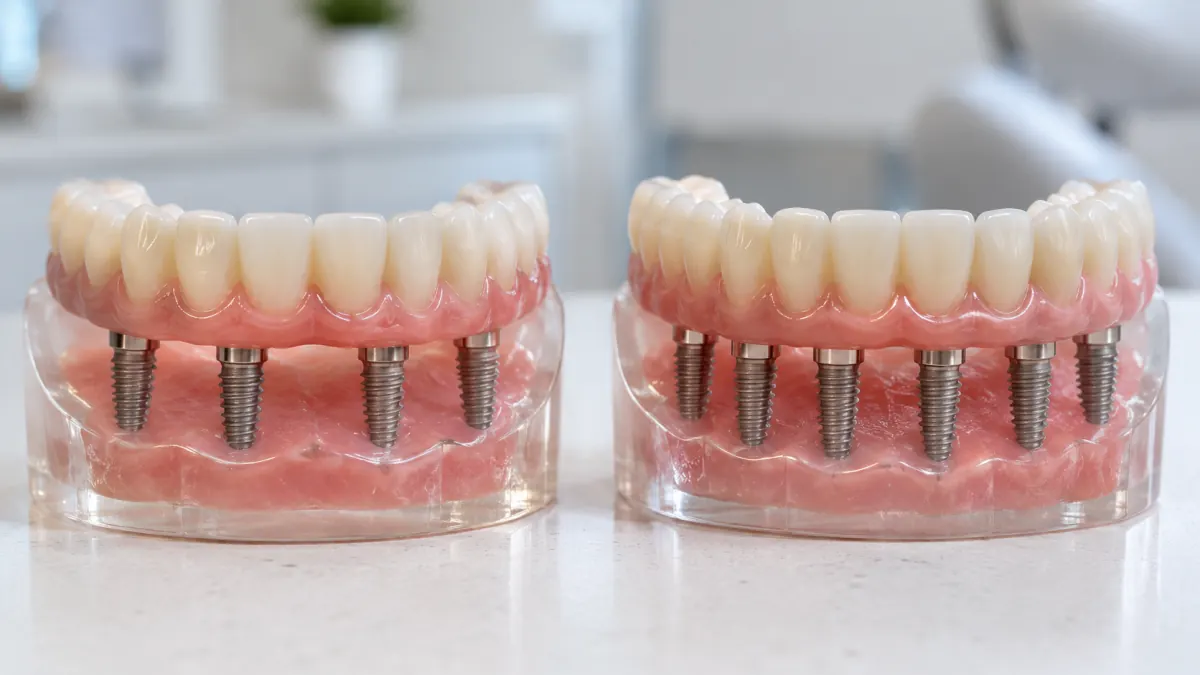
The short answer: All-on-4 and All-on-6 are two versions of the same idea, a full arch of fixed teeth held in place by dental implants. All-on-4 uses four implants per arch, often with the back two placed at an angle to make the most of available bone. All-on-6 uses six implants, which spreads chewing forces across more support points but usually needs more bone to begin with. Neither is automatically better. The right one depends on your jaw, your bite, your health and your priorities, and that is decided at an examination, not online.
That is the summary. The rest of this article unpacks the reasoning so you can walk into a consultation at our Cookstown clinic knowing what questions to ask.
What the two options have in common
Before comparing, it is worth seeing how much overlaps. In both approaches:
- Teeth that are failing are removed, and implants are placed in the jaw, often in the same appointment.
- A fixed bridge of teeth is attached to the implants. It does not come out at night, and you do not take it out to clean it.
- In many cases a provisional (temporary) bridge can be attached within a short time of surgery, so you are not left without teeth while healing. This is sometimes called “teeth in a day,” though the final bridge comes later.
- After several months of healing, the provisional is replaced by a final bridge, which may be made from materials such as zirconia or acrylic over a metal framework.
- Long-term success depends heavily on cleaning at home and regular professional maintenance.
So whether you end up with four implants or six, the day-to-day experience of living with fixed teeth is broadly similar. The differences sit mostly underneath.
How All-on-4 works
The All-on-4 concept was developed to give people with reduced bone a way to have fixed teeth without extensive grafting. Two implants go in straight toward the front of the jaw. The two at the back are tilted, angling forward so they avoid the sinus in the upper jaw or the nerve in the lower jaw while still anchoring in denser bone.
That tilting does two useful things. It allows longer implants, which can mean better initial stability, and it pushes the support points further back along the arch so the bridge has a wider base.
Because it often avoids or reduces the need for bone grafting, All-on-4 can mean fewer surgical steps and a shorter overall timeline for many patients. You can read more about how we approach it on our All-on-4 dental implants page.
How All-on-6 works
All-on-6 places six implants along the arch, usually more evenly spread and often in a more upright position. With extra implants supporting the bridge, the chewing load is divided among more points.
The trade-off is that six implants need more room. There has to be enough healthy bone in six locations, which is more likely in someone who has lost teeth recently and has not experienced much bone shrinkage. If the bone is thin in some areas, grafting may be needed before or during treatment to make six positions possible.
Side-by-side comparison
| Factor | All-on-4 | All-on-6 |
|---|---|---|
| Implants per arch | Four | Six |
| Typical implant angle | Back implants tilted | Usually more upright |
| Bone volume needed | Can work with less | Generally needs more |
| Bone grafting | Often avoided or reduced | More likely if bone is limited |
| Load distribution | Shared across four points | Shared across six points |
| If one implant has a problem | Less spare support | More remaining support |
| Surgical time | Usually shorter | Usually longer |
| Cost | Fewer implants and parts | More implants and parts |
| Cleaning around implants | Fewer sites to clean | More sites to clean |
A table like this is helpful for orientation, but it flattens a lot of nuance. For example, “less spare support” with four implants is a real consideration, yet well-planned four-implant bridges have a solid track record in the clinical literature. Likewise, six implants only help if each of them is placed in good bone.
Questions that usually point toward four implants
Your dentist will weigh many details, but certain situations tend to make All-on-4 a natural fit:
- You have worn dentures for many years and the bone has narrowed, especially in the back of the jaw.
- The upper back jaw has limited height because the sinus has expanded downward.
- You would prefer to avoid or minimise grafting for health, time or comfort reasons.
- A shorter treatment pathway matters to you, for instance because of work, travel or caregiving commitments.
- Medical factors make longer surgery less desirable. Your full health history will guide this.
Questions that usually point toward six implants
On the other hand, a six-implant plan is more often discussed when:
- There is plenty of bone across the arch, often because teeth are being removed now rather than having been lost years ago.
- You have a strong bite or a history of clenching or grinding, where spreading forces over more implants can be reassuring.
- The arch is larger, giving more room to space implants comfortably.
- You want the bridge to be split into sections later, which some six-implant designs allow, although not all do.
Notice the word “usually” in both lists. These are tendencies, not rules. Some people with good bone are still well served by four implants, and some with a heavy bite may need protective measures like a night guard regardless of the number.
The role of a 3D scan
The biggest single factor in choosing between the two is what a three-dimensional scan of your jaw reveals. It shows bone height, width and density, along with the position of the sinus and the nerve canal. From that, the dentist can see where implants can safely go and how long they can be.
If there are only four good positions, that answers the question. If six are available with or without a modest graft, then the conversation turns to your preferences, your bite and your budget. When grafting is part of the discussion, our bone grafting page explains what that involves.
Cost: what changes and what does not
People often ask whether six implants simply means a bigger bill. In general, more implants and more connecting parts do add cost, and any grafting adds more. But the final price also depends on the bridge material, whether extractions are needed, the number of appointments and the type of sedation, among other things.
Because so much depends on the individual plan, we do not publish a single full-arch figure. Your consultation will include a written estimate. You can see our general pricing information and ask about payment options during your visit.
Healing and the months in between
Recovery from the surgery itself is fairly similar for both options. Swelling and tenderness are common for the first several days, and most people follow a soft diet for a period while the implants bond with the bone. With six implants, there are more surgical sites, so some patients notice a little more soreness, though this varies widely from person to person.
The provisional bridge is designed to be worn during this time, and it is usually made of a lighter material that is a little more forgiving. After a healing phase that often lasts a few months, the dentist checks the implants and takes new records for the final bridge. If a graft was needed to make six implants possible, the overall timeline may be longer. Your dentist will give you a realistic schedule once the plan is set, so you can arrange time off work or help at home as needed.
Living with either option
Once the final bridge is in, daily life looks very similar. You will brush the bridge twice a day, clean underneath it with tools such as a water flosser or special floss, and visit for professional cleanings and checks. With six implants, there are two more sites to keep clean, which is worth knowing if dexterity is a challenge.
Most people find eating feels more stable than with a removable denture, and speaking settles in after an adjustment period. Very hard foods are still best approached with some care, to protect the bridge material.
Questions people ask us about this choice
Is All-on-6 stronger than All-on-4?
Six implants share the load across more points, which can be an advantage. However, strength depends on implant position, bone quality, bridge design and your bite, not on the count alone. A well-planned four-implant bridge can perform very well.
If one implant fails, do I lose the whole bridge?
Not necessarily. Implant failure is uncommon, but if it happens, the dentist will assess whether the bridge can be supported temporarily while the implant is replaced. Having six implants can give more margin in this situation, which is one reason some people prefer it when bone allows.
Can I choose six implants even if the dentist recommends four?
You can discuss it. If your bone supports six positions, it may be possible. If it does not, adding implants would mean grafting, more surgery and more healing time, and your dentist will explain whether that trade-off makes sense for you.
Can I have four on the top and six on the bottom?
Yes, the arches are planned individually. The upper and lower jaws often have very different bone situations, so mixed plans are not unusual.
Getting a clear answer for your mouth
Reading comparisons is a good start, but the decision really clicks into place once you have seen your own scan and talked through the trade-offs with a dentist. At My New Teeth in Cookstown, we welcome patients from Barrie, Bradford, Alliston and along the Highway 27 corridor who are exploring fixed full-arch teeth. If you already have a plan from another office and would like it reviewed, our free second opinion service is a good place to start. Otherwise, schedule a consultation and we will look at your options together.