

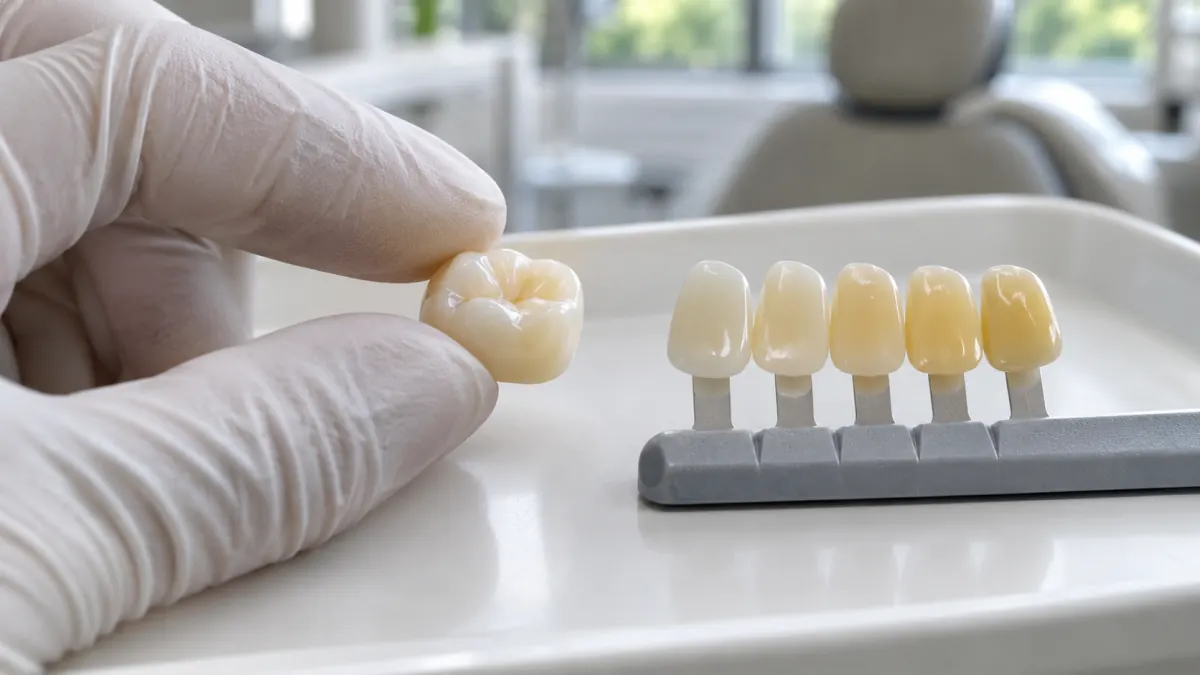
Think of a tooth as a building. A small filling is like patching a hole in one wall. It works well as long as most of the structure is still standing. But once enough walls are gone, patching stops making sense, and the building needs a new roof that ties everything together. In dentistry, that roof is a crown.
A dental crown is a custom-made cap that covers the entire visible part of a tooth above the gumline. It restores the tooth’s shape and strength and holds weakened walls together so they don’t split apart under chewing pressure. Crowns are one of the most common restorations dentists place, and at our Cookstown clinic they’re a regular part of the restorative work Dr. Daryna Kucherenko does every week.
This guide covers the situations where a crown is usually recommended, what happens during treatment, the materials you might choose between, and how to care for one so it lasts.
Why not just another filling?
It’s a fair question, and a common one. Fillings are less expensive, quicker, and keep more of your natural tooth. When a filling will do the job, it’s usually the better choice.
The trouble comes when a filling has to replace a large share of the tooth. Teeth flex slightly every time you bite. A big filling surrounded by thin walls of natural tooth acts a bit like a wedge, and over months or years those thin walls can crack. Sometimes the crack breaks off a corner, which is annoying but fixable. Sometimes it runs down toward the root, which can mean losing the tooth entirely.
A crown works differently. Instead of filling a hole from the inside, it wraps the tooth from the outside, so biting forces are spread across the whole tooth rather than concentrated on fragile walls. That’s why dentists often describe crowns as protective rather than cosmetic, even though a good crown also looks natural.
Situations where a crown is usually recommended
Every tooth is assessed on its own, but these are the patterns that most often lead to a crown.
A large or failing old filling
Many adults have silver fillings placed decades ago. When one of those breaks down, there may not be enough healthy tooth left to hold a new filling securely. A crown can be the more durable fix.
A cracked tooth
Cracks can cause sharp pain when you bite down or when you release the bite, sometimes with sensitivity to cold. If the crack hasn’t reached the root, a crown can hold the pieces together and often relieve the symptoms. Cracks are unpredictable, though, and some teeth will still need further treatment later.
After a root canal
Back teeth that have had root canal treatment tend to become more brittle, partly because a lot of tooth structure is removed to access the canals. Dentists commonly recommend crowning molars and premolars after a root canal to reduce the risk of fracture. Front teeth are sometimes managed with a filling alone if they’re otherwise intact.
Heavy wear
People who grind or clench can wear their teeth down noticeably over time. When teeth become short, sensitive, or start chipping, crowns may be part of rebuilding them — often alongside a night guard to protect the new work.
A broken tooth
A cusp that snaps off while eating is one of the most common reasons people call us unexpectedly. Depending on how much is left, a crown may be the most reliable way to restore it.
Covering an implant
When a missing tooth is replaced with a dental implant, the visible tooth on top is a crown too. It attaches to the implant rather than to a natural root.
Appearance
Crowns can improve a badly misshapen or heavily discoloured tooth. That said, for purely cosmetic changes on healthy front teeth, more conservative options such as bonding or veneers are often considered first, since they remove less tooth. Our smile makeovers page covers those options.
Signs that you might want a tooth checked
You don’t need to diagnose yourself, but these are good reasons to book an exam:
- Pain when biting that comes and goes
- A filling that feels rough, loose, or has a visible dark edge
- A piece of tooth that has chipped or broken away
- Sensitivity to cold that lingers
- A tooth that looks darker than its neighbours
- Food catching in one spot that it didn’t used to
Some of these can be handled with a simple filling or adjustment. The point of an exam is to find out which ones can.
What happens during crown treatment
Most crowns are completed in two visits a few weeks apart.
Visit one: preparation
The tooth is numbed with local anaesthetic. The dentist removes any decay or failing filling material and then reshapes the tooth, taking a thin layer off its outer surfaces so the crown has room to fit without making the tooth bulky. If too little tooth remains to support a crown, a core build-up is placed first.
Next, impressions or digital scans capture the exact shape of the prepared tooth and its neighbours. The shade is matched to your surrounding teeth. A temporary crown made of acrylic is cemented on to protect the tooth while the permanent one is made at a dental laboratory.
Living with the temporary
Temporaries are meant to be serviceable, not perfect. Avoid sticky foods like caramel and chewing gum, chew carefully on that side, and slide floss out sideways rather than snapping it up. If the temporary falls off, keep it and call the office — it’s usually a quick fix.
Visit two: fitting
The temporary comes off, the permanent crown is tried in, and the dentist checks the fit along the gumline, the contact points with neighbouring teeth, and the bite. Once everything is right, the crown is cemented or bonded in place.
It’s normal for a crowned tooth to feel slightly unfamiliar for a few days. If your bite feels high — as though that tooth hits first when you close — let us know. A minor adjustment is simple and prevents soreness.
Choosing a crown material
Today’s crowns come in several materials. The best choice depends on where the tooth is, how hard you bite, how much space there is, and what matters most to you.
| Material | Strengths | Things to consider | Often used for |
|---|---|---|---|
| Zirconia | Very strong, resists chipping, tooth-coloured | Slightly less translucent than glass ceramics | Molars, people who grind |
| Lithium disilicate (glass ceramic) | Excellent natural appearance, good strength | Not as tough as zirconia under extreme force | Front teeth, premolars |
| Porcelain fused to metal | Long track record, strong | A dark line can show at the gumline over time | Back teeth, bridges |
| Gold alloy | Extremely durable, gentle on opposing teeth | Metallic colour | Back molars where looks matter less |
There’s no single “best” material. A sensible conversation weighs appearance against durability for that particular tooth.
How long do crowns last?
With good care, many crowns last ten to fifteen years, and plenty last longer. They don’t decay themselves, but the natural tooth underneath still can, especially at the edge where crown meets tooth. Most crowns that need replacing do so because of new decay at that margin, gum recession that exposes the edge, or wear and chipping over time.
Habits that help a crown last:
- Brush twice a day and clean between teeth daily. Floss or small interdental brushes reach the margin where problems start.
- Keep up with cleanings. Your hygienist can spot early changes at the crown edge before they become serious.
- Wear a night guard if you grind. Even strong materials can chip under nightly clenching.
- Don’t use your teeth as tools. Opening packages, cracking nuts, or chewing ice puts unnecessary stress on any restoration.
- Mention changes early. A crown that suddenly feels loose or a new sensitivity is easier to address at the start.
What does a crown cost?
Our published starting fee for a crown is $1,466. That’s a starting point rather than a quote; the exact cost depends on your exam, the material chosen, and whether extra steps like a core build-up or root canal are needed. Many private dental plans cover a portion of crowns under major services, often with waiting periods or annual limits, so it’s worth checking your policy. You can see our other starting fees on the pricing page, and payment plans are available if you’d prefer to spread the cost.
When a crown isn’t the answer
Sometimes the exam shows the tooth can’t be saved — the crack runs too deep, too little structure remains, or the root is badly compromised. In those cases a crown would be money spent on a tooth that is likely to fail anyway. Replacement options then include a bridge, a removable partial, or a single dental implant. An honest assessment up front is worth far more than an expensive restoration on a tooth with a poor outlook.
Questions people ask us about crowns
Does getting a crown hurt?
The tooth is fully numbed during preparation, so most people feel pressure rather than pain. Some mild tenderness of the gum or tooth for a day or two afterwards is common and usually settles with over-the-counter pain relief.
Will the crown look like my other teeth?
Tooth-coloured materials are shade-matched to your neighbouring teeth. If you’re thinking of whitening, do it before the crown is made, because crowns won’t lighten with whitening products afterwards.
Can a tooth with a crown still get a cavity?
Yes. The crown itself can’t decay, but the natural tooth at the margin can. Daily cleaning and regular checkups are the best protection.
Do I need a root canal before a crown?
Not usually. Most crowned teeth never need root canal treatment. A root canal is only needed if the nerve inside the tooth is infected or irreversibly inflamed.
Talk to us about a weak or broken tooth
If you have a tooth that’s cracked, heavily filled, or just doesn’t feel right when you bite, it’s worth having it looked at before it breaks further. Patients come to our Cookstown office from Bradford, Innisfil, Alliston and the surrounding area for restorative care, and we’re glad to explain your options plainly.
You can book a visit online or reach the clinic at (705) 291-2222. If you’ve already been told you need a crown elsewhere and want another opinion, we offer a free second opinion as well.