
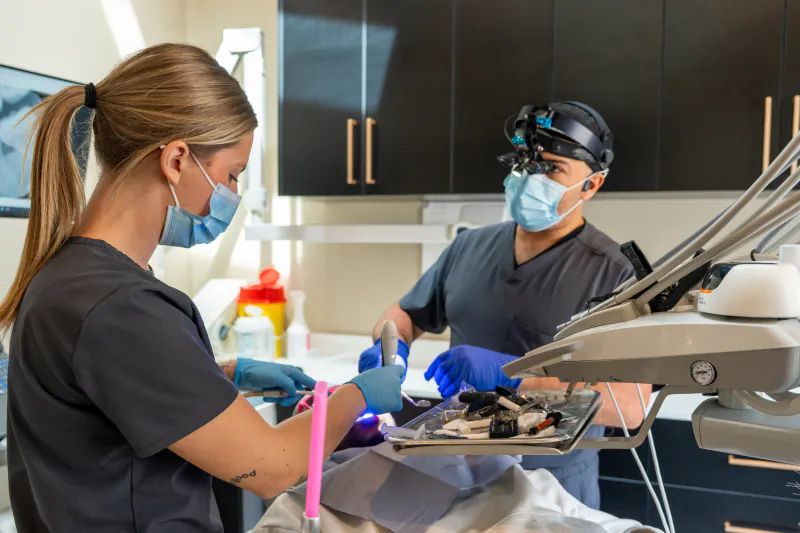

“How much is this going to hurt?” It is the question behind almost every other question we hear about dental implants, even when people do not say it out loud. Fear of pain keeps a lot of folks living with a gap, a broken tooth or a loose denture far longer than they would like.
So let us answer it directly. For most patients, the implant procedure itself is not painful because the area is fully frozen. Afterward, there is usually some soreness, swelling and tenderness for a few days, often described as similar to or milder than having a tooth pulled. Most people manage it with over-the-counter pain relievers, and many are back at work within a day or two.
That is the general picture. Everyone heals a little differently, and the experience depends on how many implants are placed, whether a tooth was extracted the same day, and whether bone grafting was needed. Below, we walk through recovery in plain terms so you know what is normal and what is not.
Why implant surgery hurts less than people expect
It helps to understand what is actually happening. A dental implant is a small titanium post placed into the jawbone through a small opening in the gum. The bone itself has relatively few pain-sensing nerves compared with, say, the pulp inside a tooth. Much of the discomfort after surgery comes from the gum tissue and the normal inflammation of healing, not from the bone.
A few other factors work in your favour:
- Local anaesthetic is thorough. The area is completely numbed before we begin. You will feel pressure and vibration, but not sharp pain.
- Sedation is available. For people who feel anxious, options such as nitrous oxide can take the edge off. Dr. Kucherenko and Dr. Khalid can talk through what suits you.
- Careful technique limits trauma. Planning the implant position in advance means the procedure can often be shorter and less invasive.
A day-by-day look at recovery
The timeline below reflects a fairly typical single-implant case. If you had several implants, an extraction or grafting at the same time, expect things to run a little longer and feel a little stronger.
The day of surgery
The freezing usually lasts a few hours. As it wears off, you will start to notice a dull ache. This is the best time to take your first dose of pain medication, before the numbness fully fades, so you stay ahead of the discomfort rather than chasing it.
Some light oozing of blood is normal for the first several hours. Biting gently on gauze helps. Rest with your head slightly raised, and apply a cold compress to the outside of your cheek in short intervals, roughly 15 to 20 minutes on and then off.
Days 2 and 3
This is usually when swelling peaks. Your cheek may look a little puffy, and the area may feel tight or tender. Some people notice mild bruising, particularly after lower implants or grafting. Discomfort is generally steady but manageable, and it should not be getting dramatically worse.
After the first day or two, many patients switch from cold to gentle warmth on the cheek to help swelling settle, if their dentist has advised it.
Days 4 to 7
Most people feel a clear turn for the better during this stretch. Swelling goes down, tenderness eases, and you may need pain relief only occasionally, or not at all. If stitches were placed, they may dissolve on their own or be removed at a follow-up visit.
Weeks 2 to 4
The gum tissue continues to heal and generally feels comfortable. You may still be on a softer diet and avoiding chewing directly on the implant site. Underneath, the important work is just beginning.
The following months
Over the next few months, the bone grows around and bonds to the implant, a process called osseointegration. This is not painful. You should not feel the implant at all during this time. Any new pain after things had settled is worth a call.
Things that can make recovery a bit more involved
Not every case follows the simplest path. Recovery may feel more noticeable if:
- A tooth was extracted on the same day. The socket heals alongside the implant site.
- Bone grafting was needed. Grafts add a bit more swelling and tenderness. Our bone grafting page explains why grafting is sometimes part of the plan.
- Several implants were placed. More surgical sites generally means more swelling, though the pattern of recovery is similar.
- You smoke. Smoking slows healing and raises the risk of complications, so we encourage patients to stop or cut back well before and after surgery.
- You have certain health conditions. Diabetes and some medications affect healing. We review your medical history carefully beforehand.
Practical ways to stay comfortable
Small habits make a real difference in how the first week feels.
For pain
- Take pain relievers as recommended by your dentist, and set reminders so you do not miss doses during the first day or two.
- If a prescription has been given, follow the directions exactly and finish any antibiotics you were prescribed.
For swelling
- Use cold compresses for the first 24 to 48 hours.
- Sleep with an extra pillow so your head stays elevated.
- Take it easy. Heavy exercise raises blood pressure and can increase swelling and bleeding for the first few days.
For eating
- Stick to soft, lukewarm foods such as yogurt, scrambled eggs, mashed potatoes, soups that are not too hot, smoothies eaten with a spoon, and well-cooked pasta.
- Chew on the opposite side.
- Avoid using a straw for the first few days, since suction can disturb the healing site.
- Skip alcohol while the area is fresh and while taking pain medication.
For cleaning
- Brush your other teeth normally, being gentle around the surgical area.
- Begin gentle salt-water rinses when your dentist advises, usually starting the day after surgery.
- Avoid vigorous swishing or spitting in the first 24 hours.
If you are spending recovery at home in Cookstown or anywhere around Innisfil and Bradford, it is worth stocking the fridge and freezer before your appointment so you are not driving to the grocery store on day two with a sore jaw.
Normal discomfort versus warning signs
Knowing the difference keeps you from worrying unnecessarily, and also helps you act quickly if something is wrong.
| Usually normal | Worth calling us about |
|---|---|
| Dull ache that improves after day 3 | Pain that gets steadily worse after day 3 or 4 |
| Swelling that peaks around day 2 or 3 | Swelling that keeps increasing after day 3 |
| Light oozing on the first day | Bleeding that will not stop with firm gauze pressure |
| Mild bruising on the cheek or jaw | Fever, chills or a bad taste with discharge |
| Slight tenderness when touching the area | Numbness of the lip or chin that lasts after the freezing should have worn off |
| A little stiffness opening wide | An implant that feels loose or moves |
If you notice anything in the right-hand column, call our office at (705) 291-2222. It is always better to check than to wait.
What about pain later on, with the final tooth?
Once the implant has fused with the bone, the next steps, such as placing the connector and taking impressions for the crown, are usually much simpler. Many patients need little or no freezing for these stages, and discomfort afterward is minimal.
For people having full-arch treatment such as All-on-4 dental implants, recovery naturally involves more sites at once and can feel more intense for the first several days. The overall pattern is the same, though: a few days of swelling and tenderness that steadily improve, followed by a longer period of quiet healing underneath.
Your questions, answered
Is getting a dental implant more painful than an extraction?
Many people find it about the same or easier. An extraction can involve more pulling and pressure, while implant placement is a controlled procedure in a fully numbed area. Combining the two on one day may make recovery feel a bit stronger.
How long will I need pain medication?
Most people use it regularly for the first two or three days, then occasionally after that. By the end of the first week, many need nothing at all.
Can I go to work the next day?
Often, yes, particularly after a single implant and if your job is not physically demanding. Some people prefer to take a day or two off, especially after multiple implants or grafting.
Will I be awake during the procedure?
Usually you are awake but fully numb. If you are nervous, ask about sedation options during your consultation so we can plan a visit that feels manageable for you.
Should the implant hurt months later?
No. Once healed, an implant should feel comfortable. Pain, swelling or bleeding around an implant later on needs to be checked.
Ready to talk it through?
Worry about pain is completely understandable, and you do not have to sort through it alone. At My New Teeth in Cookstown, we take the time to explain each step, review your health history, and talk about comfort options before anything is booked. To see how the process works from start to finish, visit our how it works page, or call us at (705) 291-2222 to arrange a consultation and ask every question on your list.