
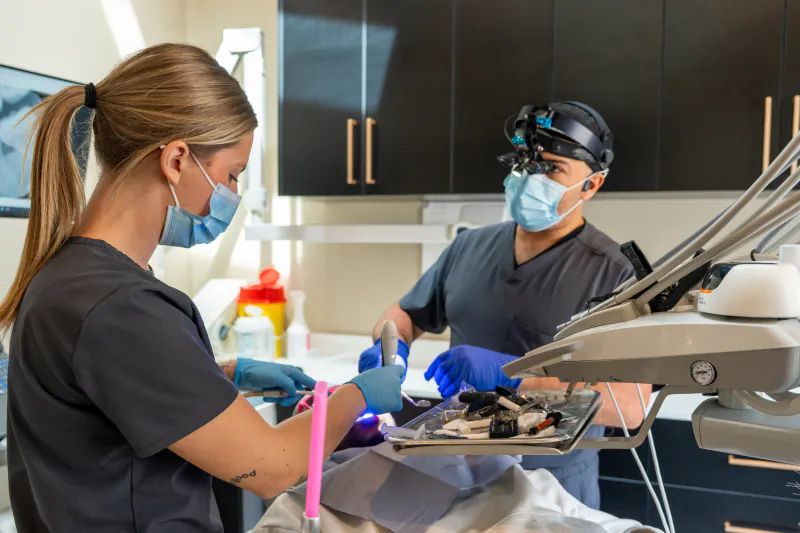

“Should I save it or pull it?” It is one of the most important questions a patient can ask about a damaged tooth, and the honest answer is that it depends. Not in a vague, noncommittal way, but on a set of specific things a dentist can look at: how much healthy tooth is left, what the bone and gums around it look like, whether the tooth has been treated before, and what you want for the long run.
At My New Teeth in Cookstown, we offer both root canal therapy and dental implants, which means we have no reason to push you toward one or the other. What follows is the same reasoning we walk through with patients in the chair, laid out so you can think it over at home.
Two Very Different Approaches
What a root canal does
Inside every tooth is a space containing the pulp, a soft tissue with nerves and blood vessels. When deep decay, a crack or trauma lets bacteria reach the pulp, it can become inflamed or infected. That is often what causes a throbbing toothache, sensitivity that lingers after hot drinks, or a swelling near the gum.
A root canal removes the damaged pulp, cleans and shapes the canals inside the roots, and seals them. The tooth stays in place, with its own root anchored in the bone by the natural ligament that gives teeth that tiny bit of cushion when you bite. Back teeth in particular usually need a crown afterwards, because a tooth that has had a root canal tends to be more brittle and the crown helps protect it from fracturing.
What an implant does
A dental implant replaces the tooth entirely. The tooth is removed, the site heals (sometimes with a bone graft), and a titanium post is placed into the jawbone. After the bone bonds to the post, an abutment and a custom crown are attached. The result looks and works like a tooth, but nothing about it can decay or need a root canal again.
You can read more about the full process on our single dental implant page.
The Case for Keeping Your Natural Tooth
There is a principle many dentists share: if a tooth can be predictably saved, it is usually worth saving. Here is why.
- Natural feel. Your own tooth keeps its ligament, which gives subtle feedback when you chew. Implants feel solid and natural to most people, but they connect to bone directly and lack that ligament.
- Fewer steps, usually. A root canal and crown can often be completed over a couple of visits, whereas an implant involves extraction, healing and restoration over a period of months.
- Lower upfront cost in many cases. Root canal treatment plus a crown usually costs less than extraction, implant and crown combined. Our published fee for a crown starts from $1,466, and an implant starts from $4,500, though actual costs for either path depend on your exam.
- Gum and bone stay as they are. Keeping the root helps preserve the surrounding bone and gum contour, which can matter a lot for front teeth where appearance is critical.
Root canal treatment has a strong track record when the tooth is a good candidate and is properly restored afterwards. Many treated teeth last for decades.
When Saving the Tooth Is Less Predictable
The word “predictable” carries a lot of weight. Some teeth can technically be treated, but the odds of long-term success are lower. Situations that often tip the balance toward extraction include:
A vertical crack in the root
A crack that runs down the root generally cannot be repaired. A root canal will not fix it, and bacteria can continue to leak through. In these cases, removal is usually the recommended route.
Too little tooth left above the gum
If decay has destroyed most of the visible tooth, there may not be enough structure to hold a crown securely. Sometimes additional procedures can create more room, but they add cost and complexity, and the outcome is less certain.
Advanced gum disease around that tooth
A root canal treats the inside of the tooth. If the bone supporting it has been lost to gum disease, the tooth may stay loose even after a perfect root canal.
A failed previous root canal
Retreatment is possible and sometimes very successful. But each retreatment or surgical procedure on the same tooth tends to have more variables, and at some point the more reliable long-term choice may be replacement.
The overall plan for your mouth
If several neighbouring teeth are also failing, it may make more sense to plan a broader solution, such as multiple implants, rather than investing heavily in one tooth that sits in a compromised area.
A Side-by-Side Look
| Factor | Root canal + crown | Extraction + implant + crown |
|---|---|---|
| Keeps your natural root | Yes | No |
| Typical treatment span | A few weeks | Several months, including healing |
| Number of procedures | Usually two to three visits | Extraction, placement, restoration (sometimes grafting) |
| Can decay again | The tooth can still develop decay | Implant cannot decay; gums still need care |
| Upfront cost | Generally lower | Generally higher |
| Long-term outlook | Excellent for good candidates | Excellent for good candidates |
Both columns end the same way for a reason. Each option does very well when the case is chosen carefully, and less well when it is not.
What About Doing Nothing?
Sometimes people ask whether they can simply leave an infected tooth alone if it stops hurting. Pain can fade because the nerve has died, but the infection often remains and can spread into the surrounding bone. Over time this can cause an abscess, more bone loss, and in rare cases more serious health issues. Leaving a gap after extraction without replacing the tooth can also lead neighbouring teeth to drift and the opposite tooth to over-erupt, changing your bite.
Waiting is a decision too, and it is worth making with full information.
Does It Matter Which Tooth It Is?
Quite a bit, actually. Front teeth and back teeth face different demands, and that shapes the recommendation.
Front teeth have a single root that is usually simpler to treat, and they take lighter chewing forces. Appearance matters most here, so keeping the natural root can help preserve the delicate gum line around the tooth. On the other hand, the bone over the front of upper teeth is often thin, and if it has been damaged, replacing the tooth with an implant can take careful planning to look natural.
Molars have two to four roots, some of them curved, which makes root canal treatment more involved. They also handle the heaviest bite forces, so a crown afterward is especially important. When a molar is heavily broken down, an implant can be a sturdy long-term replacement, provided there is enough bone and, on the upper jaw, enough space below the sinus.
Premolars sit somewhere in between. Some have one root, some have two, and they are prone to cracks, which is worth checking carefully before deciding.
How We Help You Decide
At our Cookstown clinic, the decision usually comes down to a few steps:
- Examination and X-rays. We look at the tooth, the roots, the bone around them and the health of your gums.
- Testing the tooth. Simple tests help show whether the nerve is alive, inflamed or no longer responding.
- Restorability check. We consider how much sound tooth remains and whether a crown can be placed with confidence.
- Talking through your priorities. Some people strongly prefer to keep every natural tooth they can. Others want the option least likely to need further work. Budget and timing matter too.
- A clear recommendation, with alternatives. You will hear what we think is most predictable and why, along with the other options and their trade-offs.
Dr. Daryna Kucherenko provides root canal treatment and crowns, and our lead dentist, Dr. Khalid, works with patients on implant treatment. Having both under one roof means we can look at the tooth from both angles before recommending a direction.
If you have already been given a recommendation elsewhere and are unsure, a free second opinion can help you feel confident in your choice either way.
Common Questions
Is a root canal painful?
With modern anesthetic, a root canal usually feels similar to having a filling. The infection that leads to a root canal is often the painful part, and treatment typically brings relief. Some tenderness afterwards for a few days is normal.
Is an implant “better” than my own tooth?
Not automatically. A healthy, well-restored natural tooth is hard to beat. An implant is an excellent replacement when a tooth cannot be saved predictably, but it is still a replacement.
Can I get an implant the same day the tooth is removed?
Sometimes. Immediate placement can work when there is no active infection that would compromise healing and enough bone remains to stabilize the implant. Many cases still benefit from a healing period first. Your exam determines what is appropriate.
What if the root canal fails later?
If a treated tooth develops problems, options can include retreatment, a small surgical procedure at the root tip, or extraction and an implant. Choosing a root canal now does not rule out an implant later.
How long does each option last?
Both can last many years, often decades, with good home care and regular checkups. Longevity depends heavily on the individual tooth or site, bite forces, oral hygiene and habits like grinding.
Bringing It Back to Your Tooth
There is no universal winner in the root canal versus implant debate. There is only the right choice for one specific tooth in one specific mouth. If you have a tooth that is aching, cracked or has been flagged on an X-ray, the best next step is a proper look. Patients visit us from Bradford, Innisfil, Barrie and the surrounding area for exactly this kind of decision. You can see our published starting fees on the pricing page, then book an exam and we will help you weigh it up honestly.