Picture two carpenters asked to hang a heavy shelf. One taps the wall, guesses where the stud is and starts drilling. The other uses a stud finder, measures twice, marks the spot and checks the level before the first screw goes in. Both might end up with a shelf on the wall. Only one of them knew what was behind the drywall before they started.
Dental implant treatment works on a similar principle, except the “wall” is your jawbone and the things hiding behind it are nerves, sinus cavities, roots of neighbouring teeth and bone that may be thicker or thinner than it looks from the outside. Three-dimensional imaging and digital planning are the stud finder and tape measure of modern implant dentistry. For patients in Cookstown and the surrounding townships weighing up dental implants, understanding this planning stage can make the whole process feel far less mysterious.
This article walks through what a 3D scan actually captures, how a digital plan is built, what it can and cannot do, and the questions worth asking at your consultation.
Why a regular X-ray is only part of the picture
Most people are familiar with the small bitewing X-rays taken at checkups, and many have had a panoramic X-ray that wraps around the whole mouth. These two-dimensional images are useful. They show cavities, bone levels between teeth, old root canal fillings and a general overview of the jaws.
The limitation is in the name: two dimensions. A flat image cannot tell your dentist how wide the bone is from cheek side to tongue side. It can blur or stretch structures depending on how the head is positioned. It can also stack things on top of each other, so a nerve canal and a ridge of bone may appear in the same spot on the film when in reality one sits well below the other.
For a filling, that is rarely a problem. For an implant, which is a titanium or zirconia post placed several millimetres into bone, width and depth matter a great deal. An implant needs enough bone surrounding it on every side to remain stable for years. Placing it too close to the lower jaw’s nerve canal can cause numbness. Placing it too high in the upper back jaw can push into the sinus.
What a 3D scan shows that a flat image can’t
The most common 3D imaging used for implant planning is cone beam computed tomography, usually shortened to CBCT. The patient stands or sits still while a scanner rotates around the head for a short time, capturing a series of images that software reconstructs into a three-dimensional model of the jaws.
From that model, a dentist can slice through the bone at any angle, much like slicing a loaf of bread to see the inside of each piece. That lets them see:
- Bone height and width at the exact spot where an implant might go, measured in millimetres rather than estimated.
- Bone density, which gives a sense of how firm the bone is and how well an implant might hold on the day it is placed.
- The path of the inferior alveolar nerve in the lower jaw, which supplies feeling to the lower lip and chin.
- The floor of the maxillary sinus in the upper back jaw, and how much bone sits beneath it.
- The roots of neighbouring teeth, including whether they lean or curve toward the gap.
- Hidden problems such as old infections, cysts, retained root tips or areas where bone has thinned after a long-ago extraction.
Many patients are surprised to learn that a gap which looks perfectly healthy from the outside may have lost a good deal of bone width underneath. When a tooth is removed, the bone that once held it tends to shrink over time, particularly from the cheek side. A 3D scan reveals this clearly, which is often when a conversation about bone grafting begins.
A word about radiation
It is reasonable to ask about radiation exposure. A dental CBCT scan generally delivers a higher dose than a single bitewing X-ray, but typically a much lower dose than a conventional medical CT scan of the head, and the field of view can often be limited to only the area being studied. Your dentist should weigh whether 3D imaging is genuinely needed for your situation and explain why. If you are pregnant or think you may be, say so before any imaging is taken.
How a digital implant plan comes together
The scan is the starting point, not the plan itself. A digital plan usually combines several pieces of information.
1. The 3D bone image
This shows the foundation: what bone is there, how much, and where the sensitive structures sit.
2. A record of the teeth and gums
This might be a digital intraoral scan (a small wand that captures the surface of the teeth and gums) or traditional impressions that are later scanned. Bone images show hard tissue well but do not capture the gum surface or the shape of the teeth in fine detail, so this second record fills the gap.
3. The planned final tooth
This is the step that separates careful planning from simply “finding bone and putting an implant in it.” In a restoration-driven approach, the dentist first designs where the final crown or bridge should sit so that it lines up with your bite, looks natural next to your other teeth and can be cleaned properly. Only then do they position the implant underneath it.
Think of it as designing the house before pouring the foundation. An implant that sits in good bone but at an awkward angle can leave the crown looking bulky, catching food or placing uneven force on the post. Working backwards from the final tooth helps avoid that.
4. Virtual placement
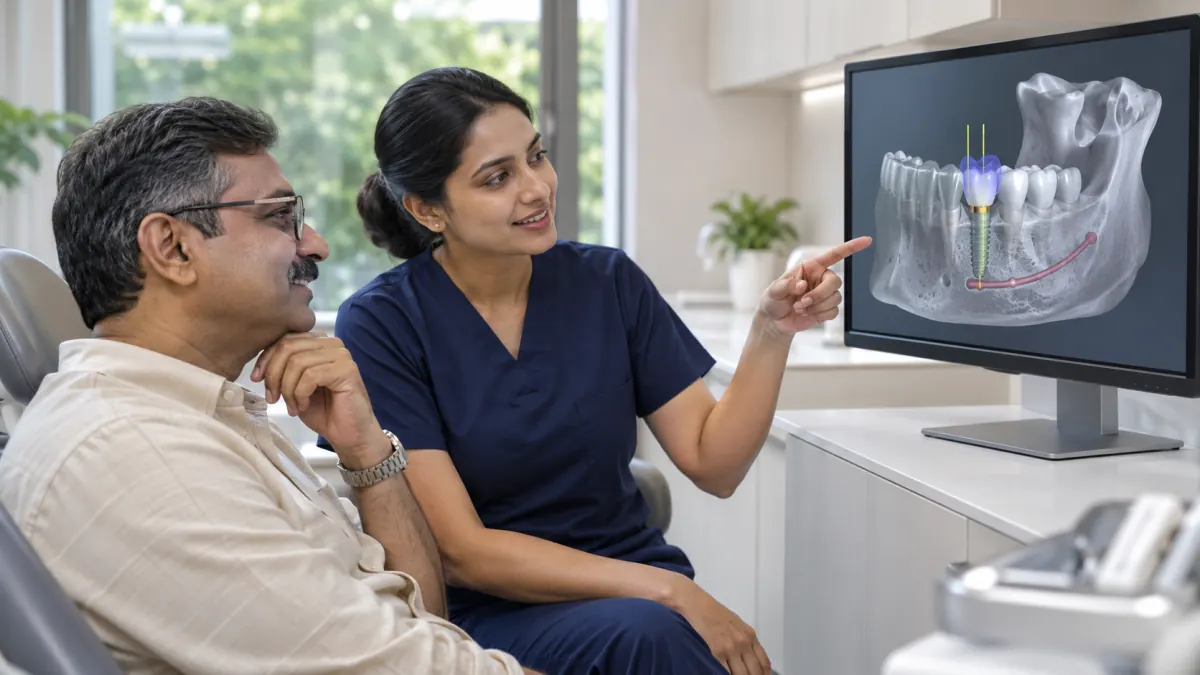
With these layers merged, the dentist can place a virtual implant on screen, adjust its length, diameter and angle, and check the clearance to the nerve, sinus and neighbouring roots from every direction. If the ideal position doesn’t have enough bone, the plan can include grafting, a different implant size or a change in approach altogether.
Guided surgery: turning the plan into reality
Once the digital plan is complete, some cases use a surgical guide. This is a custom-made plastic template, often 3D printed, that fits over the teeth or gums and has a sleeve positioned exactly where the implant should go. During the procedure the drills pass through that sleeve, which helps transfer the angle and depth from the computer to the mouth.
Guided surgery has some real advantages:
- It helps keep the implant where it was planned, particularly near nerves or sinuses.
- It can allow smaller openings in the gum in suitable cases, which may mean less swelling afterward.
- It can make appointments more predictable in length.
- For full-arch treatments such as All-on-4 dental implants, it can help coordinate several implants so the final bridge fits as designed.
Not every case needs a guide. A straightforward single implant in a wide area of healthy bone may be placed freehand by an experienced dentist working from the 3D plan. The key point is that the plan exists and has been checked before the procedure, whatever method is used to carry it out.
What precision means for you as a patient
All of this technical detail can feel distant from what you actually care about, which is likely some combination of comfort, appearance, cost and how long the result lasts. Here is how planning connects to each of those.
| What you care about | How careful planning helps |
|---|---|
| Comfort during and after | Fewer surprises mid-procedure and, where suitable, smaller incisions |
| Safety | Measured distances from nerves and sinuses rather than estimates |
| How it looks | Implant positioned to support a natural crown shape and gum line |
| How long it lasts | Implant surrounded by enough bone and loaded evenly by the bite |
| Cost clarity | Grafting or extra steps identified at the start, not discovered halfway |
| Speed | Clearer picture of whether same-day teeth may be an option |
That last row deserves a closer look. Placing teeth on the same day as implants depends on the implants being firmly stable at placement. A 3D scan gives the dentist a much better idea of whether the bone is likely to provide that stability. It doesn’t guarantee it, since the final decision is made in the chair, but it helps set realistic expectations before the day itself.
What digital planning can’t do
It is worth being honest about the limits, because no technology replaces judgment.
- It can’t change your biology. Healing depends on your overall health, smoking status, conditions such as diabetes, and how well the area is kept clean afterward.
- It isn’t perfectly exact. Small variations can happen between the plan and the final position. Good planning keeps those variations small and away from critical structures.
- It doesn’t replace an examination. Gum health, bite habits such as grinding, and your medical history all shape the plan in ways a scan alone cannot show.
- It doesn’t remove the need for maintenance. An ideally placed implant still needs daily cleaning and regular professional checkups.
A trustworthy dentist will talk about both sides. If anyone presents a scan or a piece of software as a promise of a perfect outcome, that is a reason to ask more questions.
Questions worth asking at your consultation
Whether you are seeing us in Cookstown or getting opinions elsewhere, these questions help you understand how your treatment will be planned:
- Will 3D imaging be used for my case, and if not, why not?
- Is the implant position being planned around where the final tooth needs to be?
- Do I have enough bone, or will I need grafting first?
- Will a surgical guide be used, and what does it add in my situation?
- How close is the planned implant to the nerve or sinus?
- What could change on the day, and how would you handle it?
- What is included in the quoted fee, and what might be added?
If you already have a treatment plan from another office and want a fresh set of eyes on it, our free second opinion is a no-pressure way to compare notes.
How planning fits into the overall process
At My New Teeth, the path to an implant usually starts with a consultation where we listen to what is bothering you, review your health history and examine your mouth. Imaging and records follow as needed. From there, the plan is discussed in plain language, including options, timing and costs. Our how it works page lays out these steps in more detail.
On fees: our published starting price for a single implant is $4,500 CAD. The final figure depends on your examination, including whether grafting or other preparation is needed, which is one more reason the planning stage matters. You can see our published fees on the pricing page and learn about spreading costs over time through payment plans.
Patients come to our Queen Street office from Cookstown itself and from Bradford, Innisfil, Alliston and the Barrie area. A thorough planning visit is often the most useful hour of the whole journey, because it turns “I think I might need an implant” into a clear picture of what is actually possible.
Frequently asked questions
Does a 3D scan hurt?
No. You simply stay still while the scanner moves around your head. It doesn’t touch your teeth and usually takes well under a minute of actual scanning.
Will I need a 3D scan for a single implant?
Many dentists consider 3D imaging very helpful for implant planning, even for a single tooth, because it shows bone width and nearby structures that a flat X-ray cannot. Whether it is recommended for you depends on the area and what other images already show.
Can I see my own scan and plan?
In most cases, yes. Seeing the bone and the planned implant position on screen helps many people understand why a recommendation is being made. Feel free to ask your dentist to walk you through it.
If my plan shows I need a bone graft, does that mean implants aren’t possible?
Not necessarily. Grafting is a common step that rebuilds bone in areas that have thinned. Sometimes a different implant size or approach avoids grafting altogether. An exam and your images will show which options make sense.
Does digital planning make treatment more expensive?
Imaging and planning are part of doing implant treatment carefully, and they can actually help keep costs predictable by spotting extra steps early. Ask what is included in any fee you are quoted so you can compare fairly.
Ready to see what’s beneath the surface?
If you’ve been told you need an implant, or you are simply curious whether one could replace a missing tooth, a planning conversation is the right first step. Call our Cookstown office at (705) 291-2222 or book a consultation online, and we’ll take a careful look before anything else happens.