
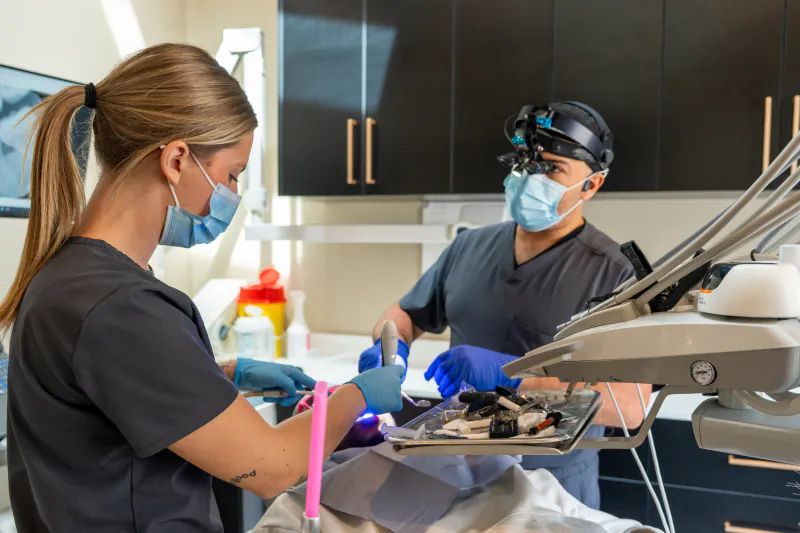

“Is this tooth worth saving?”
It is one of the most common questions we hear in our Cookstown office, and one of the hardest to answer in a sentence. Sometimes the person asking has a single molar that has been filled three times and now has a crack running through it. Sometimes they have several teeth that have started to feel loose, a bridge that keeps coming unglued, or a mouthful of old dental work that seems to need fixing every few months.
What these situations share is a feeling of being stuck. Spending money on repairs that don’t last is frustrating. Losing teeth feels drastic. And everyone seems to have an opinion, from the neighbour who swears by her dentures to the cousin who had implants and loves them.
This article won’t make the decision for you, because only an examination can do that. What it will do is explain how dentists think through the question, which signs point toward saving and which point toward replacing, and what the options look like on both sides.
First, what does “failing” actually mean?
A failing tooth is not simply a tooth with a problem. Plenty of teeth have problems that are easily fixed. A tooth is usually described as failing when the problems are progressive, repeated or structural, meaning the foundation itself is in trouble rather than just the surface.
Common examples include:
- Advanced gum disease that has destroyed much of the bone holding the tooth, leaving it loose.
- Large or recurrent decay, especially under old crowns or fillings, that has eaten deep into the root.
- Vertical root fractures, where a crack runs down into the root rather than across the crown.
- Repeated infection in a tooth that has already had root canal treatment.
- Very little tooth structure left after years of fillings, so that there’s not enough to hold a new restoration.
- Teeth worn down by grinding to the point where the bite has collapsed.
One failing tooth is a single decision. Several failing teeth, particularly when they are spread around the mouth, turn into a broader planning question about your whole bite.
The case for saving a tooth
There is a good reason dentists generally try to keep natural teeth when it makes sense. Your own tooth comes with a ligament that cushions chewing forces and gives you a subtle sense of how hard you are biting. It keeps the bone around it active. And no replacement, however good, is quite the same as the original.
Saving a tooth often makes sense when:
- The root is sound and well supported by bone.
- The decay or crack can be fully removed and the remaining structure restored.
- The surrounding gums are healthy or can be made healthy.
- The tooth plays an important role in your bite.
- The restoration needed is likely to last a reasonable number of years.
Treatments used to save teeth include fillings, root canal therapy, crowns that wrap and protect weakened teeth, and gum treatment to control infection. At our office, Dr. Daryna Kucherenko focuses on restorative care such as crowns and root canals, which are often the core of a save-the-tooth plan. Our published starting fee for a crown is $1,466 CAD, with the exact cost depending on what your exam shows.
The case for replacing a tooth
There comes a point where repeated efforts to save a tooth can cost more, in money, time and discomfort, than replacing it, without offering a better long-term result.
Replacement often deserves serious consideration when:
- The tooth is loose because most of its supporting bone is gone.
- A crack extends deep into the root.
- There is not enough healthy structure left to hold a crown.
- The tooth has already had several rounds of treatment and keeps failing.
- Keeping the tooth would require a long chain of procedures with uncertain odds.
- Ongoing infection around the tooth is affecting the bone nearby.
That last point matters more than many people realize. A tooth with a long-standing infection or advanced gum disease can keep eroding the bone around it. Waiting too long can mean losing bone that would otherwise have supported an implant, which sometimes turns a simple replacement into one that needs bone grafting first.
A side-by-side way to think about it
This table is a simplified guide, not a diagnosis. Real decisions depend on details that only an exam and X-rays can show.
| Situation | Often leans toward | Why |
|---|---|---|
| Small to moderate decay, healthy root | Saving | Straightforward repair with good long-term odds |
| Infected nerve, solid root and bone | Saving (root canal + crown) | Tooth can usually be kept and protected |
| Crack confined to the crown | Saving (crown) | Covering the tooth can hold it together |
| Crack running into the root | Replacing | Root cracks generally can’t be reliably repaired |
| Severe bone loss, tooth very loose | Replacing | Not enough support left to stabilize it |
| Third or fourth repair on the same tooth | Case by case | Depends on what remains and the cost of yet another fix |
| Several failing teeth across both jaws | Overall plan | Individual repairs may not make sense together |
When several teeth are failing at once
One tooth is a fairly contained decision. When three, five or ten teeth are in trouble, the picture changes, and it is helpful to step back from the tooth-by-tooth approach.
Imagine someone with a few loose lower front teeth from gum disease, two upper molars with large cracked fillings and a bridge on one side that keeps failing. Fixing each problem separately might involve gum treatment, a couple of root canals, new crowns and a replacement bridge, spread over many visits and still leaving several teeth with doubtful outlooks. Alternatively, the plan might keep the healthiest teeth and replace the weakest group with implants, or, in more advanced cases, consider a full-arch solution.
Options for replacing multiple teeth include:
- Multiple single implants for a few missing teeth in different spots. See our page on multiple dental implants.
- Implant-supported bridges, where two or more implants carry a bridge of several teeth.
- Partial dentures, a removable and more affordable option, though less stable than implant-based teeth.
- Full-arch options such as All-on-4 dental implants or implant dentures, for people whose teeth in one jaw are mostly failing.
There is no single right answer. Someone with strong teeth on one side and failing teeth on the other may do best with a mixed approach. Someone whose remaining teeth are all weakened may be happier with a fresh start on that arch. The goal is a plan that holds together as a whole rather than a patchwork of fixes.
Questions to ask yourself
Clinical factors set the options. Your own priorities help choose among them. It is worth reflecting on questions like these before your appointment:
- How much does keeping my natural teeth matter to me, even if it means more upkeep?
- Am I tired of repeated repairs, or would I rather try once more?
- How do I feel about removable teeth compared with fixed ones?
- What does my budget look like now, and is spreading the cost over time realistic?
- Am I comfortable with surgery, or would I prefer to avoid it if possible?
- How much time can I give to treatment over the next several months?
There are no wrong answers here. A good dental team should shape the plan around them, not the other way around.
The cost question, honestly
Money is part of every one of these decisions, and it is fine to say so. Saving a tooth may look cheaper at first, but a root canal, a post and a crown on a tooth with a guarded outlook can add up, and if it fails a few years later, the cost of replacement still lies ahead. On the other hand, replacing a tooth that could have been saved for a modest fee is not a good use of money either.
For reference, our published starting fees are $1,466 for a crown, $3,500 for a bridge and $4,500 for a single implant, all in Canadian dollars. These are starting points, and the exact cost always depends on an examination. We also offer payment plans for people who prefer to spread treatment over time, and our pricing page lists published fees in one place.
Getting a second look
If you have been told a tooth “has to come out” and you aren’t sure, or you’ve been told it can be saved but you’re doubtful it will last, it is entirely reasonable to get another opinion. Our free second opinion is designed for exactly this situation. Bring any X-rays or treatment plans you have, and we’ll go through them with you.
Frequently asked questions
How long can I leave a failing tooth before deciding?
It depends on the problem. A cracked tooth or an active infection can get worse quickly and should be seen soon. A tooth with slowly progressing gum disease may allow more time to plan, but delay can still mean losing bone. Pain, swelling or a tooth that suddenly loosens should be checked promptly.
Is it better to have a root canal or an implant?
When the root and surrounding bone are healthy, a root canal and crown are often a good way to keep a natural tooth. When the root is cracked or badly weakened, an implant may be the more reliable choice. Your dentist will look at the specific tooth before recommending either.
Can I keep some teeth and replace others?
Yes, and this is often the most sensible plan. Strong teeth can be kept and protected while weaker ones are replaced with implants, a bridge or a partial denture, so long as the overall plan works together.
Do I need to replace a back tooth if no one can see the gap?
Missing back teeth affect chewing and can let neighbouring and opposing teeth drift over time. Replacement isn’t always urgent, but it is worth discussing so you understand what may happen if the space is left open.
Let’s look at your teeth together
Deciding what to do with failing teeth is easier when you can see what’s going on and hear your options laid out clearly. Our team at 9 Queen St in Cookstown has helped patients from across Simcoe and York regions sort through these decisions since 2018. Call (705) 291-2222 or request an appointment, and we’ll start with a careful exam and an honest conversation.