
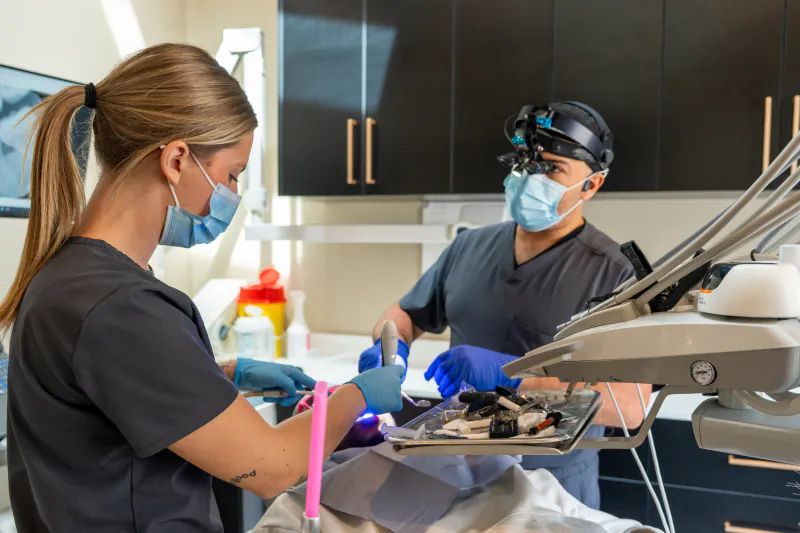

Most people who phone us about implants have been thinking about it for a long time. Some have been living with a gap for years. Others have a cracked molar that finally gave up over the summer, or a partial denture that never quite felt right. Almost all of them say a version of the same thing when they arrive: “I don’t really know what to expect today.”
That uncertainty is reasonable. An implant consultation is not a cleaning and not a filling appointment, and it doesn’t look much like either. This post explains what usually happens during a first implant visit at our Cookstown clinic, why each step matters, and what you can do beforehand to get the most out of the time.
The short version
If you only read one section, read this one. A first implant consultation generally includes:
- A conversation about what is bothering you and what you would like to change.
- A review of your medical history and medications.
- A clinical examination of your teeth, gums, bite and the area where a tooth is missing.
- Imaging, usually x-rays and, when needed, a 3D scan of the jaw.
- A discussion of options — which may include implants, but may also include bridges, dentures or keeping a tooth you assumed was lost.
- A written plan with an estimate, and time for your questions.
You are not committing to anything by booking. Nothing surgical happens at this visit. It is an information-gathering appointment for both sides.
Before you arrive
A little preparation turns a good consultation into a very useful one.
Bring a list of your medications. That includes prescriptions, over-the-counter pills you take regularly, and supplements. Blood thinners, osteoporosis medications (especially bisphosphonates or denosumab), diabetes medications and immune-suppressing drugs can all affect implant planning. A photo of your pill bottles on your phone works fine.
Bring any recent dental x-rays if you have them. If you have seen another dentist in Barrie, Bradford or Alliston in the last year or so, ask them to send your images. Sometimes they can be reused, which may reduce the need for repeat x-rays.
Write down your questions. People routinely forget the one thing they most wanted to ask. A note on your phone helps.
Think about your goals. Are you mainly concerned about chewing? Appearance? A denture that moves? Cost? There is no wrong answer, but knowing your priority helps the dentist steer the conversation.
Check your coverage. If you have private insurance or are enrolled in the Canadian Dental Care Plan, bring your details. Our page on the Canadian Dental Care Plan explains how we work with it, though coverage for implants specifically is limited and varies.
Step one: the conversation
The appointment usually starts with talking rather than looking. Dr. Khalid or one of our team will ask what brought you in, how long the problem has been going on, and what you have already tried.
This part isn’t small talk. Your story shapes the plan. Someone who lost a front tooth in a fall last month has very different needs from someone who has worn a lower denture for fifteen years and can no longer keep it in place. Someone who is nervous about dental work needs a different pace than someone who just wants the facts.
It is also your chance to be honest about worries. If you have had a bad experience elsewhere, if you are anxious about needles, or if budget is the main concern, say so early. It changes how we present information, not how seriously we take you.
Step two: your health history
Dental implants are placed in living bone, and the body has to heal around them. That is why general health matters as much as the state of your mouth.
Expect questions about:
- Heart conditions and blood pressure, and whether you take blood thinners.
- Diabetes, and how well it is controlled. Well-managed diabetes is usually not a barrier, but poorly controlled blood sugar can slow healing.
- Bone health, including osteoporosis and the medications used to treat it.
- Smoking and vaping. Tobacco use is one of the more significant risk factors for implant complications, and we will ask about it directly.
- Past radiation therapy to the head or neck.
- Allergies, especially to medications or anaesthetics.
- Teeth grinding or clenching, which can overload implants if it isn’t managed.
None of these automatically rules you out. Many people with health conditions have implants placed safely. The point is to know about them so the plan accounts for them, and in some cases so we can coordinate with your family doctor.
Step three: the clinical exam
Next comes the hands-on part. The dentist looks at much more than the gap itself.
The site
How much gum and bone appears to be present where the tooth is missing? Is the area healed, or was the tooth only recently removed? Is there any infection nearby?
Neighbouring teeth
Are the teeth on either side healthy, or do they already have large fillings or crowns? This matters because one of the alternatives to an implant — a bridge — involves shaping those neighbours. If they are pristine, an implant may protect them. If they already need crowns, a bridge becomes a more reasonable comparison.
Gums
Active gum disease needs to be treated before any implant is placed. Bacteria that damage natural tooth support can do the same around an implant. Our hygienist, Anna Porth, may be involved in getting the gums healthy first.
Your bite
How your upper and lower teeth meet affects where an implant can go and how much force it will take. Signs of grinding, such as flattened or chipped edges, are noted.
The rest of your mouth
A first consultation is a good moment to look at the whole picture. If several teeth are struggling, a single implant might not be the best use of your money right now, and a broader plan could make more sense.
Step four: imaging
Standard dental x-rays show a flat image of teeth and bone. They are useful, but they can’t show the width of the jawbone or exactly where nerves and sinuses sit.
That is why many implant cases also involve a 3D scan, often called a CBCT scan. It takes a short time, you stay seated or standing, and the radiation dose for a focused dental scan is generally modest. The result lets the dentist measure the bone in three dimensions and see important anatomy before planning anything.
From those images, the dentist can tell whether there is enough bone to hold an implant or whether some rebuilding would be needed first. If bone has shrunk after an old extraction — which is very common — a bone graft may be part of the plan. In the upper back jaw, the sinus sometimes sits low enough that a sinus lift is discussed.
Not everyone needs a 3D scan at the first visit. Sometimes the x-rays make it obvious that something else has to happen first, and the scan is scheduled later.
Step five: talking through the options
This is where the appointment becomes a real conversation about choices. A good implant consultation should not feel like a sales pitch. You should hear about every reasonable option, including the ones that cost less.
Depending on your situation, those may include:
| Situation | Options commonly discussed |
|---|---|
| One missing tooth | Single dental implant, a bridge, a removable partial, or leaving the gap |
| Several missing teeth in a row | Implant-supported bridge, conventional bridge, partial denture |
| Most or all teeth failing in an arch | Full-arch options such as All-on-4, implant dentures, conventional dentures |
| Loose existing denture | Snap-on implant denture, fixed implant bridge, a reline or new denture |
The dentist should explain the trade-offs: how long each option tends to last, how it feels day to day, how you clean it, what it does to the bone over time, and what it costs. Implants tend to cost more upfront, but they don’t rely on neighbouring teeth and they help preserve the jawbone. A bridge is quicker and often cheaper at the start but involves trimming healthy teeth. A partial denture is the most affordable but is removable and can feel bulky.
Sometimes the honest answer is that a tooth you thought was hopeless can be saved with a root canal and crown. That is a perfectly good outcome for a consultation.
Step six: timeline, cost and next steps
Once you and the dentist have narrowed down an approach, you’ll get a sense of the sequence and timing. A straightforward single implant usually involves placing the implant, letting it fuse with the bone for roughly three to six months, then attaching the final crown. If a graft or extraction comes first, the timeline stretches. Full-arch treatment can sometimes include temporary teeth on the same day, which is something we explain on our same-day teeth options page.
For cost, our published starting fee for a single implant is $4,500. That figure is a starting point. The exact cost depends on what your exam and imaging show — whether you need a graft, what type of crown is used, and how many teeth are involved — so the written estimate you receive after your consultation is the number to plan around. Our pricing page lists other starting fees, and we can talk about payment plans if spreading the cost would help.
You’ll leave with your plan to take home. There is no expectation that you decide on the spot. Many people want to talk it over with a partner, check insurance, or simply sleep on it.
How long does it take?
Plan for roughly an hour, sometimes a bit more if a 3D scan is done the same day or if your case involves many teeth. If you are coming from Innisfil or further down the Highway 400 corridor, it is worth leaving a little cushion for traffic so the visit doesn’t feel rushed.
What a good consultation should feel like
It’s worth knowing what to look for, whether you see us or someone else:
- You were asked about your goals, not just told what you need.
- You saw your own x-rays or scan and had them explained.
- More than one option was discussed, including at least one that wasn’t an implant.
- Risks were mentioned plainly — implants have a high success rate in healthy patients, but they are surgery and nothing is guaranteed.
- You received costs in writing.
- Nobody pressured you to book the procedure that day.
If any of those were missing from a consultation you had elsewhere, a free second opinion can be a reasonable next step.
Common questions about the first visit
Will the consultation hurt?
No. It involves an exam, some gentle probing of the gums, and imaging. There are no injections or drilling. If you’re sensitive, let us know and we’ll go slowly.
Do I need a referral from my regular dentist?
No referral is needed. You can contact our Cookstown clinic directly. If you have a regular dentist, we’re happy to share findings with them so your care stays coordinated.
Can the implant be placed on the same day as the consultation?
Usually not. Planning needs the exam and imaging results first, and some people need gum treatment or grafting beforehand. Certain full-arch cases can move quickly once planned, but the consultation itself is for gathering information.
What if I’m told I’m not a good candidate?
That’s not always the end of the story. Low bone can often be rebuilt, and health factors like blood sugar or smoking can sometimes be improved before treatment. If implants truly aren’t suitable, there are other good ways to replace teeth, and we’ll walk you through them.
Should I bring someone with me?
You’re welcome to. A second set of ears can be helpful when you’re hearing about options and costs for the first time.
Ready when you are
A first consultation is about clarity: understanding what is happening in your mouth, what your realistic options are, and what each one involves. You leave knowing more than when you arrived, whatever you decide.
If you’ve been putting off that first step, you can book a consultation online or call our Cookstown office at (705) 291-2222. We’ll find a time that works and take it from there, one question at a time.