
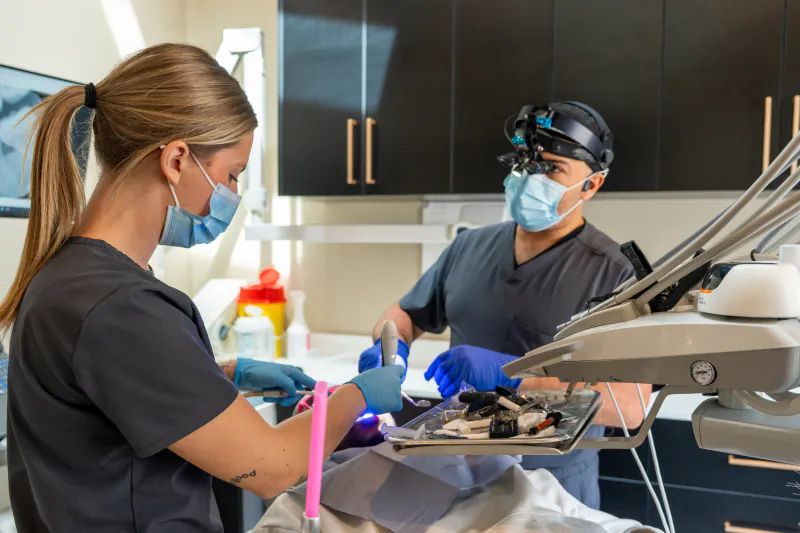

For many people, the hardest part of losing their remaining teeth is not the extraction itself. It is the thought of walking out of the clinic, past the receptionist, into the parking lot and back to work or family with no teeth at all.
Immediate dentures exist to solve that problem. They are made before your extractions and placed in your mouth the same day the teeth come out. You leave with a full smile, even though your gums underneath are only beginning to heal.
That convenience comes with a learning curve. Your mouth is changing rapidly in the weeks after extractions, and the denture has to keep up. Knowing what is normal, and what is not, makes the whole experience far less stressful. Below, we follow the journey that patients at our Cookstown clinic typically go through, from the planning visits through to the point where most people are ready for a longer-term solution.
First, a quick definition
An immediate denture is a removable denture, full or partial, that is fabricated in advance from impressions and measurements of your mouth while your teeth are still present. On the day of extraction, the teeth are removed and the denture is inserted right away.
It differs from a conventional denture, which is made only after the gums have healed for several months. Conventional dentures usually fit more precisely at first, because they are built on a settled ridge. The trade-off is a period without teeth.
Immediate dentures are also different from the fixed, implant-supported teeth some people receive on the day of extraction. We will come back to that distinction near the end.
Before extraction day: the planning visits
At our Cookstown clinic, you will typically have a few appointments before the teeth come out. These may include:
- An exam and X-rays to confirm which teeth need removal and check the health of the bone and gums.
- Impressions of your upper and lower jaws.
- Bite records that capture how your jaws relate to each other.
- Choosing the shade and shape of your new teeth. This is a good moment to mention anything you liked or disliked about your natural smile.
Because the denture is made while your teeth are still in place, the lab has to predict what your gums will look like once those teeth are gone. That is why the first fit is a close approximation rather than a perfect match, and why adjustments afterwards are expected.
It also helps to plan your home life for the first few days. Stock soft foods, arrange a lighter work schedule if you can, and have someone available to drive you home if you are receiving sedation.
Extraction day
On the day itself, the area is numbed and the teeth are removed. The denture is then placed over the fresh extraction sites. It acts a little like a bandage, applying gentle pressure that helps control bleeding and protects the healing tissue.
You will usually be asked to leave the denture in for the first 24 hours and not remove it until your follow-up visit. Taking it out too early can let the gums swell, and you may struggle to get it back in.
It is normal to feel:
- Numbness for several hours
- A full, bulky sensation in your mouth
- Some oozing of blood mixed with saliva
- Difficulty speaking certain sounds
The first 24 to 48 hours
This is the most uncomfortable stretch for most people, though everyone’s experience is different. A few things help:
- Rest with your head raised on an extra pillow.
- Use cold packs on the outside of your face for short periods to limit swelling.
- Take pain medication as directed by your dentist. Do not wait until the discomfort becomes strong.
- Stick to cool, soft foods and liquids such as yoghurt, smoothies (no straw), applesauce, broth that has cooled, and pudding.
- Avoid smoking, alcohol and vigorous rinsing. These can disturb blood clots in the sockets.
Swelling often peaks around the second or third day and then gradually settles.
The first follow-up visit
Usually within a day or so, you return to the clinic. The dentist removes the denture, checks how the extraction sites are healing, and looks for any spots where the denture is pressing too hard. Small adjustments here make a big difference to comfort.
You will also be shown how to take the denture out, clean it and put it back in, and given instructions for rinsing with warm salt water.
Weeks one and two
This is a period of adaptation. Expect the following:
Sore spots
As the swelling goes down, the denture may rub in new places. Sore spots are very common and are usually easy to fix with a quick adjustment. Do not try to file or reshape the denture at home.
Speech
Your tongue is learning a new environment. Sounds like “s,” “f” and “th” may come out a little differently. Reading aloud for a few minutes each day speeds up the adjustment considerably.
Saliva
Many people produce extra saliva for the first while. This usually settles as the mouth gets used to the denture.
Eating
Keep foods soft and cut them small. Chew slowly, using both sides of your mouth at the same time to keep the denture stable. Biting into things with your front teeth tends to tip the denture, so cut food rather than tearing it.
Weeks three to eight
By now, the sockets are closing over and tenderness has faded for most people. You will likely be wearing the denture more comfortably, eating a broader range of soft-to-moderate foods, and speaking more naturally.
You may also notice the denture feels looser than it did at first. This is completely expected. As the swelling resolves and the bone beneath the extraction sites begins to remodel, the shape of your gums shrinks. The denture, however, stays the same size.
Months two to six: the ridge keeps changing
The most significant bone and gum changes happen in the first several months after extraction. During this time your dentist may place a soft temporary liner inside the denture. This cushions the gums and fills the growing space between the denture and the ridge.
Some people use a denture adhesive during this phase. Adhesive can help, but it is not a substitute for a good fit. If you find yourself using more and more of it, that is a signal the denture needs attention.
After healing: reline, rebase or a new denture
Once the gums have settled, usually somewhere around three to six months after extraction depending on the person, you and your dentist decide on the next step. The common options are:
| Option | What it involves | When it is chosen |
|---|---|---|
| Hard reline | A new fitting surface is added inside the existing denture | The teeth and base are in good shape, only the fit is off |
| Rebase | The entire pink base is replaced, keeping the teeth | The base is worn or stained, teeth are fine |
| New conventional denture | A fresh denture made on the healed ridge | The immediate denture was always meant as an interim, or appearance and bite need a change |
| Implant-supported option | Implants placed to anchor a denture or fixed bridge | You want more stability and less movement |
Many people treat their immediate denture as a transitional set and move on to a final denture afterwards. Others are happy with a reline. A published starting fee for a complete upper or lower denture at our clinic is $2,600; the exact cost depends on your exam and which approach suits you.
Daily care habits that make a difference
- Remove and rinse after meals once your dentist says it is fine to take the denture out.
- Brush the denture daily with a soft brush and a non-abrasive denture cleaner. Regular toothpaste can scratch it.
- Clean your gums and tongue with a soft brush or damp cloth.
- Store it in water or a soaking solution when it is out, unless instructed otherwise, so it does not dry and warp.
- Give your gums a rest. Once healing is under way, most dentists recommend leaving dentures out overnight.
When to call the clinic
Call us at (705) 291-2222 if you notice:
- Bleeding that does not slow with gentle pressure
- Swelling that increases after the third day
- Fever, a bad taste or pus around an extraction site
- A sore spot that keeps you from wearing the denture
- A crack or broken tooth on the denture
What if you want something that does not move?
Immediate dentures are a practical, affordable way to stay comfortable through extractions. But some people find that a removable denture, especially on the lower jaw, never feels quite secure.
If that sounds like you, there are other routes. Implant dentures snap onto a small number of implants for far better stability. Fixed dentures are permanently attached to implants and can only be removed by the dentist. In some cases, treatments such as All-on-4 allow fixed temporary teeth to be placed on the day of extraction, which avoids the removable stage entirely. Whether that is possible depends on your bone, health and goals, which only an assessment can confirm.
It is also worth knowing that an immediate denture does not close the door on implants later. Plenty of people start with an immediate denture and move to an implant solution once they have healed and had time to think.
Your questions, answered
Will my immediate denture look natural?
It can look very natural. Because it is made before your teeth are removed, the lab can use your existing teeth as a reference for shape and position, if you would like.
Can I sleep with it in?
For the first night, yes, as you will be asked to leave it in. After that, your dentist will usually advise taking it out at night to let your gums rest.
Why does it feel loose after a few weeks?
Your gums and bone shrink as they heal, which is normal. A soft liner or reline brings the fit back.
How long can I keep wearing my immediate denture?
Some people wear it, with relines, for a long time. Others replace it with a new denture once healing is complete. Your dentist can help you decide based on fit and comfort.
Talk it through with us
If you are facing extractions and want to understand whether an immediate denture is right for you, or how it compares to implant-based options, our Cookstown team is happy to walk you through it. See how our process works or call the clinic on Queen Street to arrange a consultation.