
If you have worn a conventional denture for a while, you probably know the small rituals that come with it: the adhesive in the morning, the careful first bite of an apple, the slight worry when you laugh hard at a family dinner. Many people who visit us in Cookstown are not unhappy with the idea of dentures. They are unhappy with dentures that move.
Dental implants change that by giving the denture something solid to hold on to. But “implant-supported denture” is a broad label. It covers two quite different designs: a snap-on (removable) overdenture that clicks onto implants and comes out at night, and a fixed implant bridge that stays in your mouth and is removed only by your dental team. Both are good treatments. They simply fit different mouths, budgets and personalities.
This guide walks through how each one works, what daily life looks like, and the questions that usually decide the choice.
First, why anchor a denture at all?
A conventional lower denture sits on a narrow ridge of gum and bone, with the tongue and cheeks constantly nudging it. Upper dentures usually do better because they cover the palate and create suction, but they can still loosen as the jaw changes.
That jaw change is the part people are rarely told about. Once teeth are gone, the bone that used to hold them is no longer stimulated by chewing, and it gradually shrinks. A denture that fit well five years ago can feel loose today, not because the denture changed but because the ridge underneath did. Relines help, but they chase the problem rather than slowing it.
Implants are small titanium (or occasionally zirconia) posts placed into the jawbone. Once they bond with the bone, they act as anchors. Loading them through chewing also helps maintain the bone around them, which is one of the main reasons people consider implant dentures rather than another conventional set.
Option one: the snap-on overdenture
How it works
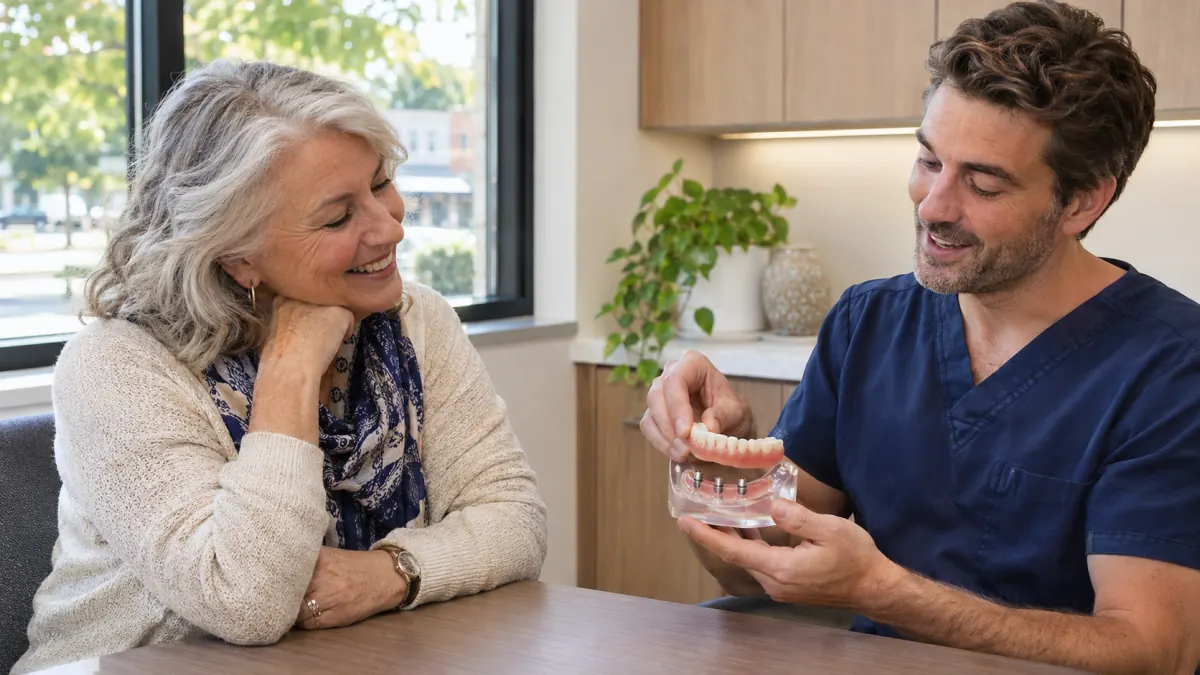
A snap-on denture looks a lot like a regular denture from the outside. The difference is underneath. The implants are fitted with attachments — commonly small ball-style or locator-style abutments, or a slim metal bar connecting the implants — and the denture has matching housings with replaceable nylon inserts. When you press the denture into place, it clicks onto the attachments and stays put.
On the lower jaw, two implants are often enough to make a dramatic difference in stability. Many clinicians plan two to four lower implants depending on bone and bite. Upper overdentures usually need more implants, often four or more, because upper bone tends to be softer.
What daily life looks like
- You remove the denture each evening, clean it, and clean around the implant attachments with a soft brush.
- You put it back in the morning with a firm press until it clicks.
- The nylon inserts wear with use and are typically swapped out at maintenance visits — often every year or so, depending on how you chew and how often you remove the denture.
Where snap-on dentures shine
- Lower cost than a fixed bridge, mainly because fewer implants are usually required and the denture itself is simpler to make.
- Easier cleaning, since you can take the whole thing out and see everything.
- A good fit for limited bone, as two well-placed implants can sometimes be managed where a full fixed bridge would need bone grafting first.
- Lip and cheek support can be built into the acrylic flange, which helps people who have lost a lot of ridge and want fuller facial contours.
The trade-offs
A snap-on denture still moves slightly. It is far steadier than a conventional denture, but it can rock a little under heavy chewing, and some food can collect under it. Upper overdentures may still cover part of the palate, though implants can sometimes allow a more horseshoe-shaped, palate-free design. And it is still something you take out — which some people do not mind at all, and others find is exactly what they wanted to leave behind.
Option two: the fixed implant bridge
How it works
A fixed implant-supported denture is screwed onto four or more implants and stays in place. You do not take it out at night. Your dental team removes it at maintenance visits to clean underneath and check the implants. The best-known approach is All-on-4, where four implants support a full arch; some cases call for five or six implants instead.
With many fixed full-arch plans, a provisional (temporary) bridge can be attached shortly after the implants are placed, so you are not left without teeth during healing. After a few months, once the implants have integrated, the final bridge is made, often in a stronger material such as zirconia or a reinforced acrylic. You can read more about how this works on our fixed dentures page.
What daily life looks like
- You brush the bridge like natural teeth, twice daily.
- You clean underneath it with a water flosser, superfloss or small interdental brushes, focusing on where the bridge meets the gum.
- You visit for professional maintenance, typically every three to six months at first, and the bridge may be taken off periodically for a deeper clean.
Where fixed bridges shine
- They feel the most like natural teeth. No clicking in and out, no movement when chewing.
- No palate coverage on the upper arch, which many people say improves taste and speech.
- Stronger bite for tougher foods, once healing is complete.
- Nothing to remove, which matters a great deal to people who are self-conscious about dentures.
The trade-offs
Fixed bridges need more implants and more bone, so the overall investment is higher. Cleaning underneath takes some practice and a little more daily commitment. And because the bridge is not removed at home, keeping maintenance appointments is not optional; skipped visits are where problems around implants tend to start.
Side-by-side comparison
| Snap-on overdenture | Fixed implant bridge | |
|---|---|---|
| Removed by | You, daily | Your dental team, at maintenance visits |
| Typical implants per arch | Often 2–4 lower, 4+ upper | Usually 4–6 |
| Feel when chewing | Stable, with slight movement possible | Fixed, closest to natural teeth |
| Palate coverage (upper) | Sometimes reduced, may still be partial | None |
| Daily cleaning | Remove and brush denture and attachments | Brush and clean beneath bridge in place |
| Ongoing parts | Nylon inserts replaced periodically | Screws and bridge checked; occasional repairs |
| Relative cost | Lower | Higher |
These are general patterns, not rules. Your own implant count and design depend on a clinical exam and 3D imaging of your bone.
Questions that usually decide it
When we talk through this choice with patients at our Cookstown clinic, a handful of practical questions tend to settle it more than any brochure does.
How do you feel about taking your teeth out? Some people find a removable denture perfectly normal, especially if they have worn one for years. Others want their teeth to simply be teeth. Be honest with yourself here; it matters more than people expect.
How is your dexterity? Snap-on dentures need a firm press to seat and a deliberate pull to remove. Fixed bridges need careful cleaning in tight spaces. Arthritis in the hands, tremor, or limited vision can tilt the decision either way, and sometimes a family member’s help is part of the plan.
How much bone do you have? A CT scan shows the height and width of the jaw. If bone is thin, a two-implant lower overdenture may be possible without grafting, while a fixed bridge might need more preparation.
What does your budget allow? Neither option is inexpensive, but the gap between them is real. It is worth seeing both treatment plans priced out before deciding.
Upper, lower, or both? It is common for someone to have a fixed bridge on one arch and a snap-on on the other, or to start with a lower overdenture and plan the upper later. Mixing approaches is completely reasonable.
A word on cost
Every implant denture plan is individual, so the only accurate number comes after an exam. For context, our published starting fees list a single dental implant from $4,500 and a complete upper or lower denture from $2,600; an implant-supported denture combines elements of both, and the final figure depends on the number of implants, any grafting, the attachment type and the material of the final teeth. We offer payment plans, and we accept the Canadian Dental Care Plan for eligible patients, though coverage for implant work is limited and is confirmed case by case.
If you have already received a quote elsewhere and want another set of eyes on it, our free second opinion is a no-pressure way to compare.
What the process usually looks like
- Consultation and imaging. A full exam, a review of your health history, and imaging to measure bone — for implant planning this usually includes a 3D scan. We talk through both designs and what each would mean for you.
- Planning. Implant positions are mapped digitally so the teeth and the implants are designed together.
- Implant placement. Done under local anaesthetic, with sedation options available for anxious patients. Depending on the plan, you may leave with a provisional fixed bridge or with your existing denture adjusted to fit over the healing implants.
- Healing. Commonly three to six months while the implants integrate with the bone. A soft-food diet is recommended early on.
- Final teeth. The final overdenture or bridge is made and fitted, with bite adjustments over the following weeks.
- Maintenance. Regular hygiene visits, insert changes for snap-on designs, and periodic removal and cleaning for fixed bridges.
Timelines vary with bone quality, healing and whether grafting is needed. Our how it works page gives a broader overview of the patient journey.
Common questions about snap-on and fixed implant dentures
Can I start with a snap-on denture and switch to fixed later?
Sometimes. If the original implants are positioned and numbered in a way that can support a fixed bridge, upgrading may be possible by adding implants. It depends on bone and on the original plan, so mention this goal at your first visit so it can be planned for.
Will people be able to tell I have dentures?
A well-made implant denture of either type is designed to look natural. Fixed bridges have the advantage of never needing to come out, which many people find reassuring in social situations.
Do I sleep with a snap-on denture in?
Generally no. Removing it overnight lets the gums rest and gives you a chance to clean the denture and the attachments properly. Your dentist will give you specific instructions.
Are implant dentures suitable if I have worn dentures for decades?
Often, yes, though long-term denture wearers may have more bone loss. Imaging shows what is available, and grafting or shorter or angled implants are sometimes options.
Talk it through with us
Choosing between a snap-on and a fixed implant denture is less about which is “better” and more about which suits how you live, eat and look after your teeth. Dr. Khalid and our team in Cookstown are happy to lay both options side by side, show you what your scans reveal, and give you clear numbers to think about at home. When you are ready, you can book a consultation or call us at (705) 291-2222 and we will find a time that works.