
Mini dental implants get a lot of attention online, often with headlines promising smaller surgery, lower fees and faster results. Some of that is true. Some of it leaves out important details. If you’ve been reading about them and wondering whether they’re the answer to a loose denture or a missing tooth, this guide is meant to give you the full picture before you sit down with a dentist in Cookstown or anywhere else.
First, what makes an implant “mini”?
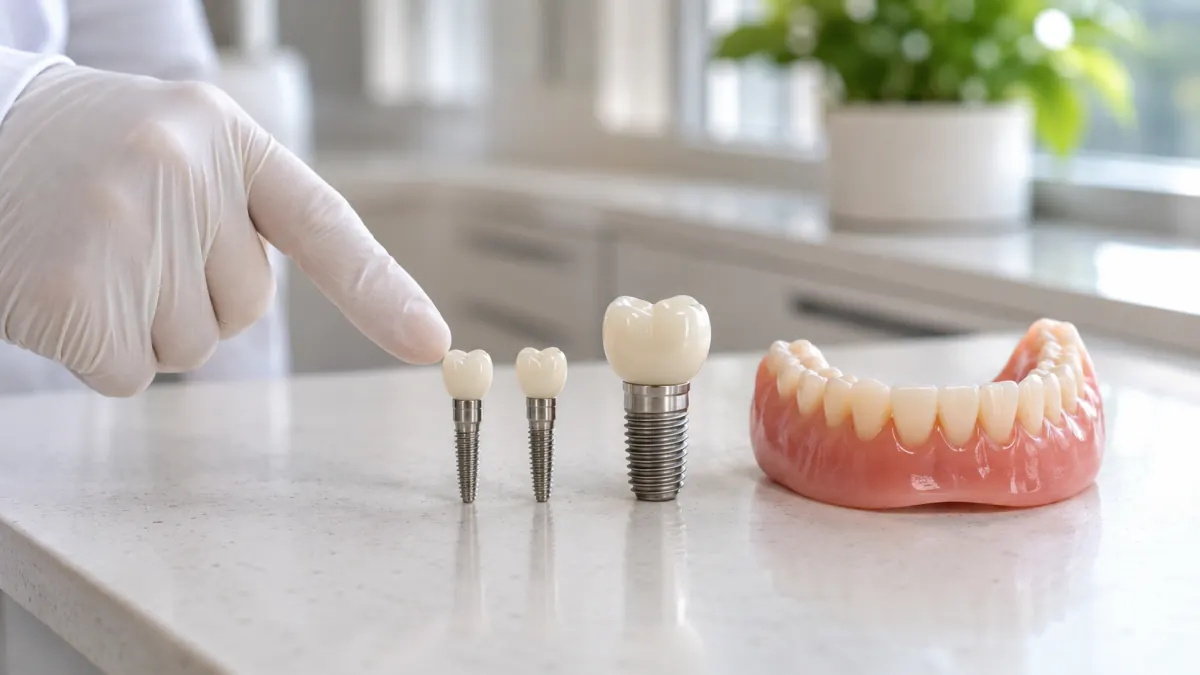
A dental implant is a small post, usually titanium, that’s placed in the jawbone to act as an artificial tooth root. Standard implants are commonly somewhere around 3.5 to 5 millimetres wide. Mini implants are narrower, generally under 3 millimetres, and are often made as one piece, with the post and the attachment on top joined together.
That smaller diameter changes several things:
- They can sometimes fit into thinner ridges of bone without grafting.
- Placement can be less invasive, sometimes through the gum without a large flap.
- They have less surface area touching the bone, which affects how much biting force they can handle.
- Their one-piece design means there’s less flexibility in angle and in what can be attached later.
Neither type is “better” in every case. They are different tools, and the right one depends on what you need them to do.
Where mini implants tend to shine
Stabilizing a lower denture
This is the classic use. Many people with a full lower denture struggle with it lifting, sliding and catching food underneath. The lower jaw often has less bone to grip a denture than the upper jaw, and the tongue tends to push it around.
Placing several mini implants in the front of the lower jaw can give the denture something to snap onto. For people who can’t have, or don’t want, grafting or larger implants, that can be a meaningful improvement in comfort and confidence.
Narrow spaces for small teeth
Sometimes a gap is too narrow for a standard implant, such as a missing lower front tooth or an upper lateral incisor (the small tooth beside the front teeth). In some of these cases, a narrow implant is the most practical choice.
Temporary support
Mini implants have also been used to temporarily support a denture or bridge while standard implants heal elsewhere in the mouth.
When surgery needs to be kept minimal
For some patients with health considerations, a less invasive procedure is a priority. A shorter appointment and smaller surgical site may make mini implants worth discussing, though overall health still needs to be reviewed carefully.
The limits you should know about
Here’s what the glossy ads don’t always mention.
Less strength under heavy chewing
Because mini implants are thinner, they have less surface area to bond with bone and are more vulnerable to bending or breaking under heavy loads. Molars handle the most chewing force in the mouth, so mini implants are usually not the first choice for replacing back teeth with fixed crowns.
Usually more implants are needed
To spread the forces out, a denture supported by mini implants often uses four or more of them, where a standard implant overdenture might use two. That narrows the cost gap between the two approaches more than many people expect.
Not ideal in soft or very thin bone
Mini implants need a reasonable amount of bone height. In the upper jaw, where bone is often softer, they may not hold as reliably as they do in the denser lower jaw. Upper dentures supported only by mini implants are more of a case-by-case decision.
Fewer options for the future
One-piece designs make it harder to change what’s attached on top. If your needs change down the road, for example if you later want a fixed bridge instead of a removable denture, standard implants usually offer more flexibility.
They don’t stop all bone loss
Any implant that’s loaded properly helps stimulate the bone around it. But with narrow implants spread across a limited part of the jaw, they won’t necessarily protect the entire ridge from shrinking over time.
Mini vs standard implants at a glance
| Mini implants | Standard implants | |
|---|---|---|
| Typical width | Under about 3 mm | About 3.5–5 mm or more |
| Common uses | Lower denture stabilization, narrow gaps | Single teeth, bridges, full-arch fixed teeth, overdentures |
| Surgery | Often less invasive | May need more access, sometimes grafting |
| Load capacity | Lower | Higher |
| Flexibility for future changes | Limited | Greater |
| Bone requirement | Less width, but still needs height and density | More width, may need grafting |
Who tends to be a good candidate
Mini implants might be worth discussing if you:
- Wear a full lower denture that moves when you eat or talk
- Have a narrow ridge of bone and want to avoid or can’t have grafting
- Need a small front tooth replaced in a tight space
- Have health reasons that make a shorter, less invasive procedure attractive
- Are looking for a removable, snap-on solution rather than fixed teeth
They may be less suitable if you:
- Need back teeth replaced with fixed crowns
- Grind or clench heavily
- Want a fixed full-arch bridge that can’t be removed
- Have very soft bone, particularly in the upper jaw
- Have very limited bone height, even if the width is fine
If you fall into the second group, a standard implant approach, sometimes with bone grafting first, may give a more durable result. For full-arch needs, our page on implant dentures explains how removable and fixed options compare.
What about cost?
Mini implants are often marketed as the low-cost option. Each individual mini implant can cost less than a standard one, but remember that more of them are often needed, and the overall plan includes the denture or crown that goes on top, imaging and follow-up care.
At My New Teeth, our published fees list a standard single implant starting from $4,500, and a complete upper or lower denture starting from $2,600. These are starting points only. The exact cost of any plan depends on an exam, imaging and the specific approach chosen. You can see more on our pricing page, and if spreading out the cost would help, take a look at our payment plans.
When comparing quotes, it’s worth asking what’s included, how many implants are planned, what type of attachment is used and what happens if one needs replacing.
The questions to bring to your consultation
Whether you end up with mini or standard implants, these questions help you understand the recommendation:
- How much bone do I have, and where?
- Why are you recommending this type and size of implant for me?
- How many implants would I need, and why that number?
- Is my result removable or fixed?
- What are the realistic long-term maintenance needs?
- What would my alternatives be, and how do they compare in cost and lifespan?
A good dentist should be comfortable walking you through these answers using your own scans. If you’ve already received a recommendation elsewhere and want another set of eyes on it, our free second opinion service is there for that.
Caring for any implant-retained denture
Whether your denture clicks onto mini or standard implants, daily care looks similar:
- Remove the denture and clean it every day, including the attachments inside it.
- Brush around each implant gently with a soft brush. Plaque around implants can cause inflammation.
- Take the denture out at night if advised, to let the gums rest.
- Expect the small rubber or nylon inserts in the denture to wear out and need replacing periodically. That’s normal maintenance.
- Keep regular check-ups so the fit and the implants can be assessed.
Quick answers
Is mini implant placement painful?
It’s done with local anaesthetic, and many people report mild soreness afterward rather than significant pain. Your experience depends on how many are placed and your own healing.
Can I use my denture right away?
Sometimes. If the implants are stable enough, a denture may be adapted to clip on soon after placement. In other cases, a short healing period is recommended first.
How long do mini implants last?
With good care and the right case selection, they can serve well for many years. Their long-term record depends heavily on bone quality, the number placed and how much force they’re asked to carry.
Are mini implants safe?
They’re an established option when used in appropriate situations. The bigger risk is using them where a standard implant would be more suitable.
The bottom line
Mini dental implants are a useful tool, especially for stabilizing a loose lower denture when bone is limited. They’re not a universal replacement for standard implants, and they come with real trade-offs in strength and future flexibility. The right answer is the one that matches your bone, your bite and your goals.
If you live in Cookstown, Alliston, Innisfil or nearby and you’re trying to figure out which approach suits you, we’d be glad to take a look. Learn more about our dental implant services, or call (705) 291-2222 to arrange an assessment. We’ll show you what we see on your scans and explain every option plainly.