“Same day teeth” is one of those phrases that sounds almost too tidy to be true. You come in with teeth that are broken, loose or missing, and you go home that evening with a full row of fixed teeth. For many patients at our Cookstown clinic, that is genuinely how the surgery day plays out. But the phrase also hides a lot of detail: the planning that happens weeks before, the reason your first set of teeth is temporary, and the healing that continues long after you leave.
This post walks through the whole process in plain language, so you know what “one visit” really means and what it doesn’t.
What “same day” actually refers to
Same day teeth usually describes a treatment where dental implants are placed and a fixed set of teeth is attached to them on the same day. The most common version replaces a whole arch (all the upper teeth, all the lower teeth, or both) using four to six implants. You may have heard this called All-on-4, full-arch implants, or fixed dentures.
The key idea is immediate loading. Traditionally, implants were left to heal under the gums for several months before any teeth were attached. With immediate loading, the implants are placed with enough initial stability that a carefully designed temporary bridge can be screwed onto them right away. You never have a day without teeth.
What “same day” does not mean:
- It doesn’t mean the whole treatment is finished in a day. The surgery and temporary teeth happen in one appointment; the final teeth come later.
- It doesn’t mean every patient qualifies. Bone quality, health history and bite all matter.
- It doesn’t mean you skip healing. Your bone still needs months to bond with the implants.
Before the big day: the planning visits
Most of the work that makes a single surgery day possible happens beforehand. At My New Teeth, the path usually starts with a consultation where we listen to what’s bothering you, look at your teeth and gums, and talk about your goals. You can read more about the general flow on our how it works page.
During the planning stage, you can expect:
- A full examination. We check each remaining tooth, your gum health, your jaw joints and how your teeth meet.
- Imaging. A 3D scan shows the height, width and density of the jawbone, plus the location of nerves and the sinuses. This is what tells us whether implants can be placed where they need to go.
- Health review. Conditions such as uncontrolled diabetes, smoking, certain medications that affect bone, or recent radiation to the head and neck can change the plan or the timeline.
- Smile design. We discuss tooth shape, colour and how much “gum” the bridge should show. Records and photos help the lab prepare your temporary teeth in advance.
- Treatment options and fees. You’ll see what’s recommended, what alternatives exist and what it costs. Our payment plans page explains financing options.
If something in the scan shows that the bone is too thin in a key area, we may talk about bone grafting or angled implants. Sometimes a graft can be done on the same day; sometimes it needs to be done first, which means the “same day” part may shift.
The surgery day, step by step
Every case is different, but a typical full-arch same day appointment follows a familiar rhythm.
Morning: comfort and preparation
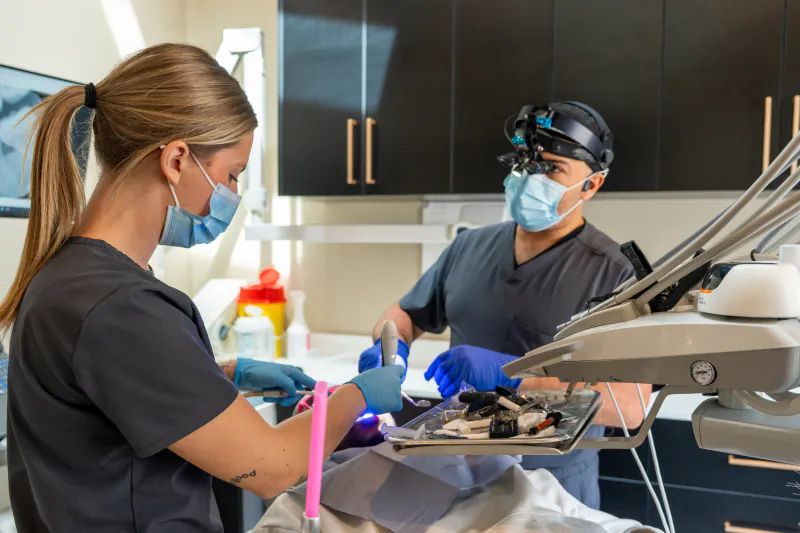
You’ll arrive, review the plan one more time, and get comfortable. Local anaesthetic is used to numb the area thoroughly. Depending on your needs and the clinic’s options, sedation may also be discussed so the appointment feels calmer. Many people say the anticipation is harder than the day itself.
Removing failing teeth
If you still have teeth that can’t be saved, they’re removed gently. Any infection or inflamed tissue is cleaned out, and the bone is shaped to create a smooth, even foundation for the bridge.
Placing the implants
The implants (small titanium posts) are placed into the jawbone at planned positions and angles. In the All-on-4 approach, the back two implants are often tilted to make the most of the available bone and avoid structures like the sinuses or the nerve in the lower jaw. Each implant is checked for initial stability. This step is what decides whether immediate loading is safe.
Fitting the temporary teeth
Once the implants are in and the gums are stitched, small connectors called abutments are attached. Your prepared temporary bridge is then adjusted, connected to the implants and polished. We check the bite carefully, because a balanced bite protects the implants during healing.
Going home
By the end of the appointment you’ll have a fixed set of teeth that you can’t remove yourself. You’ll be numb, likely a little swollen, and you’ll need someone to drive you home if sedation was used. You’ll leave with written instructions, a soft-food plan and a follow-up date.
Why your first teeth are temporary
This is the part that surprises some people. The teeth you receive on surgery day are designed for the healing phase. They’re usually made from a strong acrylic material, and they’re shaped with a slightly gentler bite to protect the implants while bone grows around them.
Over the following months, your gums shrink and settle after the extractions. Once that settling is done and the implants are firmly integrated, a final bridge is made to fit the healed shape of your mouth. The final bridge is typically stronger and more refined, and is often made from materials like zirconia or reinforced acrylic, depending on what suits your bite and budget.
Think of the temporary bridge as a well-made bridge for the road you’re on, not the destination.
The healing months after you leave
Here is a general picture of recovery. Your own timeline depends on how many teeth were removed, whether grafting was done and how your body heals.
| Period | What’s typical |
|---|---|
| First 2–3 days | Swelling and tenderness peak, then ease. Cold compresses, rest and prescribed or recommended pain relief help. |
| First 2 weeks | Liquid and very soft foods. Stitches dissolve or are removed. First check-up to review the bite and healing. |
| Weeks 2–8 | Gradual move to soft, fork-tender foods. Speech and comfort keep improving. |
| Months 3–6 | Implants bond with bone (osseointegration). Gums continue to reshape. Regular reviews. |
| Around 4–6 months | Final bridge is designed, tried in and fitted once healing is confirmed. |
During those first few months, the single biggest thing you can do to protect your implants is respect the soft-food guidelines. Biting into a crusty bun or a raw apple on the temporary bridge puts force on implants that aren’t fully bonded yet. Patience here pays off for decades.
Who tends to be a good candidate
Same day teeth may be worth exploring if:
- Most of your teeth in one or both jaws are failing because of decay, gum disease or wear
- You’re wearing a loose or uncomfortable denture and want something fixed
- You’ve been putting off dentistry because of the thought of months without teeth
- You’re in reasonably good general health, or your conditions are well controlled
- You’re willing to quit or significantly cut down on smoking, which raises the risk of implant problems
It may be less suitable, or need extra steps, if:
- There has been significant bone loss in the jaw
- You have uncontrolled diabetes or a condition that affects healing
- You take certain bone medications, especially by injection
- You grind your teeth heavily and haven’t addressed it
- You only need one or two teeth replaced, where a single dental implant or a shorter bridge may make more sense
Only an examination and a 3D scan can confirm what’s right for you. If you’ve been told elsewhere that you’re not a candidate, a free second opinion can help you see whether other approaches exist.
Same day teeth compared with other options
It helps to see same day teeth next to the alternatives most people are weighing.
Conventional dentures. Lower upfront cost and no surgery, but they rest on the gums and can move, especially on the lower jaw. Over time, the bone underneath shrinks, which makes the fit worse.
Snap-on implant dentures. A removable denture that clicks onto two to four implants. More stable than a regular denture and often less costly than a fixed bridge, but you take it out to clean it. You can learn more on our implant dentures page.
Delayed full-arch implants. The same fixed result, but with a waiting period of a few months before any implant teeth are attached. This may be recommended when bone quality is lower or stability on the day isn’t high enough.
Same day fixed teeth. Fixed from the start, no removable phase, but it requires enough bone and good stability on the day of surgery.
Questions we hear often
Does it hurt?
The surgery is done with thorough local anaesthetic, so you shouldn’t feel sharp pain during the procedure. Afterward, most people describe soreness and swelling for a few days rather than intense pain. It’s usually manageable with the medication plan we discuss with you.
How long is the appointment?
For one arch, plan on several hours in the clinic. Both arches together take longer. We’ll give you a realistic estimate at your planning visit based on your case.
Can I go back to work the next day?
Some people return within two or three days, especially to desk jobs. If your work is physical, you may want a little longer. Swelling and bruising vary from person to person.
How much does it cost?
Full-arch fees depend on the number of implants, whether grafting is needed, the type of final bridge and other factors. As a reference point, our published fees list a single implant starting from $4,500, but full-arch treatment is priced as a complete plan, and the exact cost depends on an exam. Our pricing page explains what’s included.
What if an implant doesn’t heal well?
It’s uncommon, but it can happen. If an implant doesn’t integrate, it can usually be replaced after the area heals. That’s one reason we check stability carefully on the day and see you regularly afterward.
A realistic way to think about it
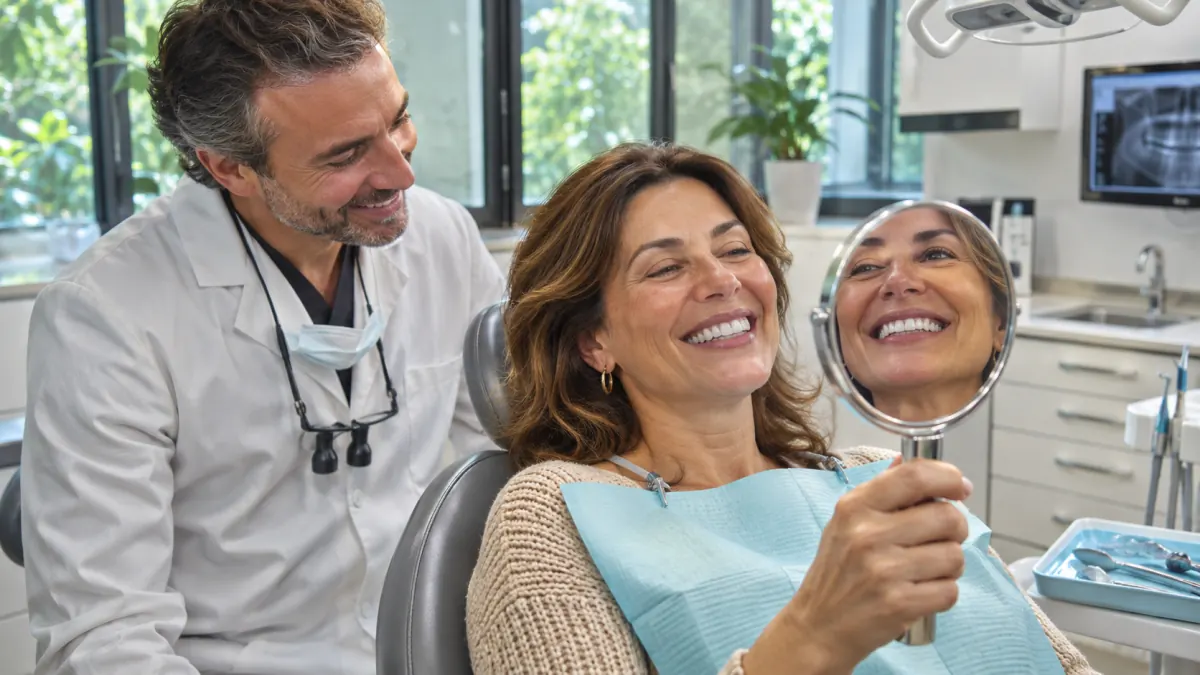
The honest summary is this: same day teeth compress the visible part of the journey into one day, but the biological part still runs on its own clock. You’ll go home with fixed teeth, and that can be a big emotional moment. Then there’s a stretch of soft foods, check-ups and gentle care while everything settles, followed by the fitting of your final bridge.
For people who’ve been hiding their smile, struggling with a loose denture or living with constant tooth pain, that trade-off is often well worth it. For others, a staged approach or a removable option might fit better. Neither is the wrong choice, as long as it’s made with good information.
Talk it through with us in Cookstown
If you’re in Cookstown, Bradford, Innisfil or anywhere along the Highway 89 corridor and you’re wondering whether a one-visit smile is realistic for you, the best first step is a conversation. Our team, led by Dr. Khalid, will look at your scans, explain what we see and give you options without pressure.
Call us at (705) 291-2222 or request a consultation online, and bring your questions. You’ll leave with a clear picture of whether same day teeth fit your mouth, your health and your plans.