
Maybe you’ve noticed it in photos first. A smile that looked fine in the bathroom mirror suddenly seems dull or yellow next to a friend’s, or one tooth stands out as darker than the rest. You try a whitening toothpaste for a few weeks. Nothing much changes.
Tooth discolouration is one of the most common cosmetic concerns we hear about in Cookstown, and it’s also one of the most misunderstood. The reason a quick fix doesn’t work is usually that it doesn’t match the type of stain you have. So before talking about solutions, it helps to understand what’s actually going on.
Two kinds of staining: outside and inside
Dentists generally sort tooth stains into two broad groups.
Extrinsic stains sit on the outer surface of the enamel. They come from things that touch your teeth every day, such as coffee, tea, red wine and tobacco. These are often the easiest to improve.
Intrinsic stains are inside the tooth, within the enamel or the dentin underneath it. They can come from injury, certain medications taken during childhood, excess fluoride while teeth were forming, or natural changes with age. These are harder to shift with surface treatments.
Many people have a mix of both. That’s why an examination is the starting point for any plan.
Common causes of stained teeth
Food and drink
Dark, strongly coloured drinks are the usual suspects. Coffee and black tea contain compounds called tannins that cling to enamel. Red wine, cola, berry juices, soy sauce, balsamic vinegar and curry can all leave their mark over time. Acidic drinks, such as citrus juice and pop, can soften enamel temporarily, making it easier for colour to grab on.
Tobacco and nicotine
Smoking and chewing tobacco leave yellow to brown stains that build up quickly and can be stubborn. Tobacco also raises the risk of gum disease, which has its own effects on how a smile looks.
Plaque and tartar
When plaque isn’t removed well, it hardens into tartar (calculus), which picks up stain easily. Tartar can’t be brushed away at home. It needs professional cleaning.
Ageing
As we get older, enamel gradually thins with wear. The dentin underneath, which is naturally more yellow, starts to show through. Teeth can also look darker simply because enamel becomes less reflective.
Trauma to a tooth
A knock to a tooth, sometimes years earlier, can damage the nerve inside it. The tooth may slowly turn grey, brown or darker than its neighbours. A single dark tooth is worth having checked, because it can mean the nerve has died and the tooth may need treatment.
Medications
Some antibiotics in the tetracycline family, when taken while teeth are forming in childhood, can cause grey or brown banding. Certain mouth rinses, like chlorhexidine, can cause surface staining with longer-term use. Some other medications can also affect tooth colour.
Fluorosis
Too much fluoride while teeth are developing can cause white spots, streaks or, in more significant cases, brown mottling. It’s usually mild and cosmetic.
Old dental work
Fillings, crowns and bonding don’t change colour the way natural teeth do. A filling placed years ago may now look darker or more yellow than the teeth around it. Whitening treatments don’t change the colour of these materials, either.
How a dentist works out the cause
At a smile consultation, we’ll typically:
- Look closely at the pattern of staining. Is it even, banded, spotty or limited to one tooth?
- Ask about your history: coffee and tea habits, smoking, childhood medications, past injuries
- Check for decay, worn enamel or old restorations that might be part of the issue
- Take X-rays if a single tooth is dark, to assess its nerve and root
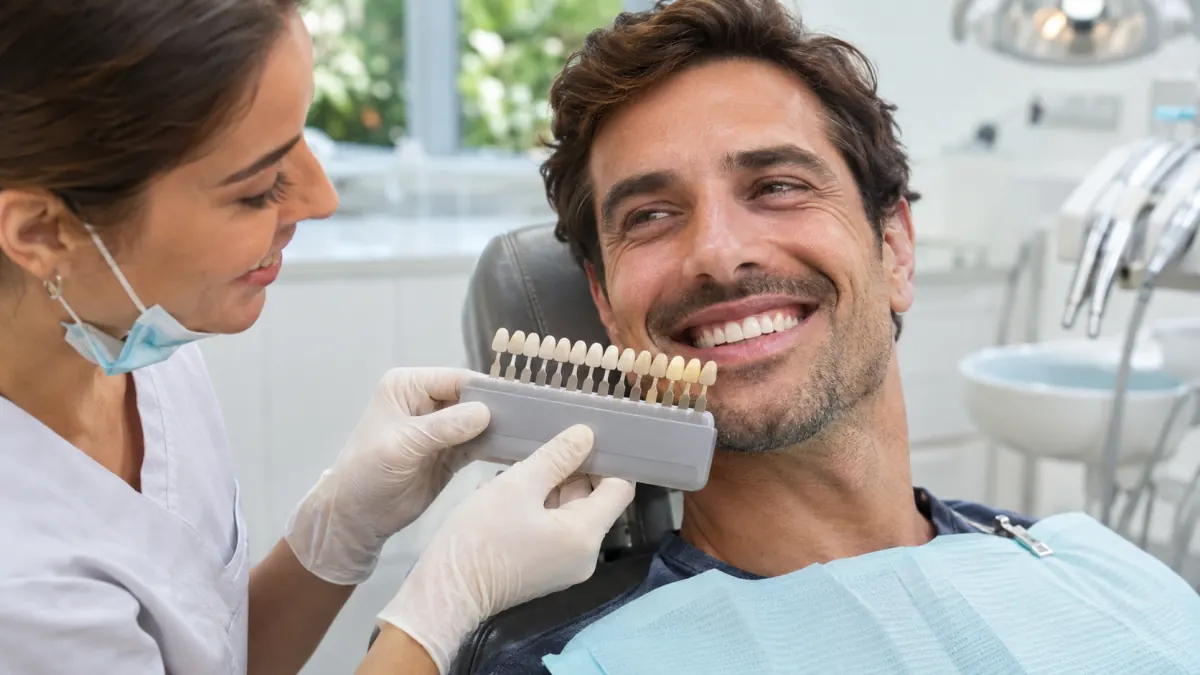
- Use a shade guide to record your current tooth colour
This tells us not only what’s causing the discolouration but also what is realistic to expect from each option.
Professional solutions, from lightest to most involved
1. Professional cleaning
For surface staining and tartar, a cleaning and polish by a hygienist can make a noticeable difference on its own. It’s also the right first step before any cosmetic work, since whitening or veneers should go on clean, healthy teeth.
2. Teeth whitening
Whitening uses peroxide-based gels to lighten the colour of the tooth itself. It tends to work best on yellowish staining from food, drink and age. It’s less effective on grey stains, such as those from tetracycline, and it won’t change the colour of fillings, crowns or veneers.
Professionally supervised whitening is generally more predictable than over-the-counter kits because the strength of the gel and how it’s applied are matched to your teeth. Sensitivity during and shortly after whitening is common and usually temporary.
A few things to know:
- Results fade gradually, especially if you keep drinking coffee or tea. Touch-ups are normal.
- If you have front fillings or crowns, they may need replacing afterward to match your new shade.
- Gum disease, cavities or worn enamel should be addressed first.
3. Composite bonding
Tooth-coloured resin is applied to the surface of the tooth, shaped and polished. It can cover small areas of discolouration, such as fluorosis spots, and also fix small chips. Bonding is relatively quick and conservative, though it can stain and chip over time and may need refreshing.
4. Porcelain veneers
Veneers are thin shells, usually of porcelain, bonded to the front of the teeth. They’re one of the most effective ways to address deep intrinsic staining that whitening can’t reach, and they can also improve shape, size and minor alignment issues at the same time.
Porcelain resists staining well. Veneers do require a small amount of enamel to be removed, which makes the treatment permanent: once a tooth has a veneer, it will always need one. Our published fees list veneers starting from $1,200 per tooth, with the exact cost depending on an exam and the number of teeth involved. You can find more on our smile makeovers page.
5. Crowns
When a tooth is both discoloured and structurally weak, for example after a root canal or a large filling, a crown that covers the whole tooth may be the better choice. Our published fees list crowns starting from $1,466, again depending on what an exam shows.
6. Treating a dark single tooth from the inside
If a tooth has darkened after trauma and the nerve has died, a root canal may be needed. Afterward, internal bleaching or a crown can be used to improve the colour.
Comparing the options
| Option | Best for | Changes shape? | Typical longevity | Reversible? |
|---|---|---|---|---|
| Cleaning | Surface stain, tartar | No | Until stain returns | Yes |
| Whitening | Yellowish, age and diet stains | No | Months to a few years, with touch-ups | Yes |
| Bonding | Small spots, chips | Slightly | Several years | Mostly |
| Veneers | Deep or resistant stains, multiple concerns | Yes | Many years with care | No |
| Crowns | Weakened, discoloured teeth | Yes | Many years with care | No |
Keeping your smile brighter for longer
Whatever treatment you choose, a few habits help:
- Rinse with water after coffee, tea or wine. It’s a simple step that reduces how much colour lingers.
- Use a straw for iced coffee or dark drinks. It limits contact with the front teeth.
- Brush twice a day and clean between teeth daily. Plaque holds stain.
- Wait about 30 minutes to brush after acidic drinks. Enamel softens briefly after acid exposure.
- Keep up with cleanings. Your hygienist can remove buildup before it becomes a visible stain.
- Quit smoking. It’s one of the best things you can do for both your appearance and your health.
When staining is a sign of something else
Most discolouration is cosmetic, but sometimes it points to a problem worth checking:
- A single tooth turning grey or dark
- Brown or black spots that feel rough or sticky, which can be decay
- Staining along the gumline along with bleeding gums
- Chalky white spots that appear around braces or in areas that are hard to clean
If you notice any of these, book an exam rather than reaching for a whitening product.
What patients often ask
Do whitening toothpastes work?
They can help remove some surface stain through mild polishing, but they don’t change the internal colour of the tooth. Results are usually modest.
Is whitening bad for my enamel?
When it’s done as directed, whitening is generally considered safe for enamel. Temporary sensitivity is the most common side effect. Overusing products, especially without guidance, can increase sensitivity and irritation.
Can a dark front tooth be fixed without affecting the others?
Often, yes. Depending on the cause, internal bleaching, a veneer or a crown on that single tooth can bring it closer to its neighbours. Shade matching is an important part of the process.
Can I whiten teeth that already have veneers?
Whitening doesn’t change the colour of porcelain. Natural teeth can be whitened before veneers are made, so the shades match.
Talk to us about your smile in Cookstown
Stained teeth are common, and they’re nothing to be embarrassed about. The right treatment depends on what’s behind the colour change, how much difference you’d like to see and how much of your natural tooth you’d like to keep.
If you’re in Cookstown, Bradford, Alliston or nearby and you’d like a clear, honest opinion, our team is happy to help. Have a look at our team, see what to expect as a new patient, or book a visit and we’ll work out a plan that fits both your smile and your budget.